
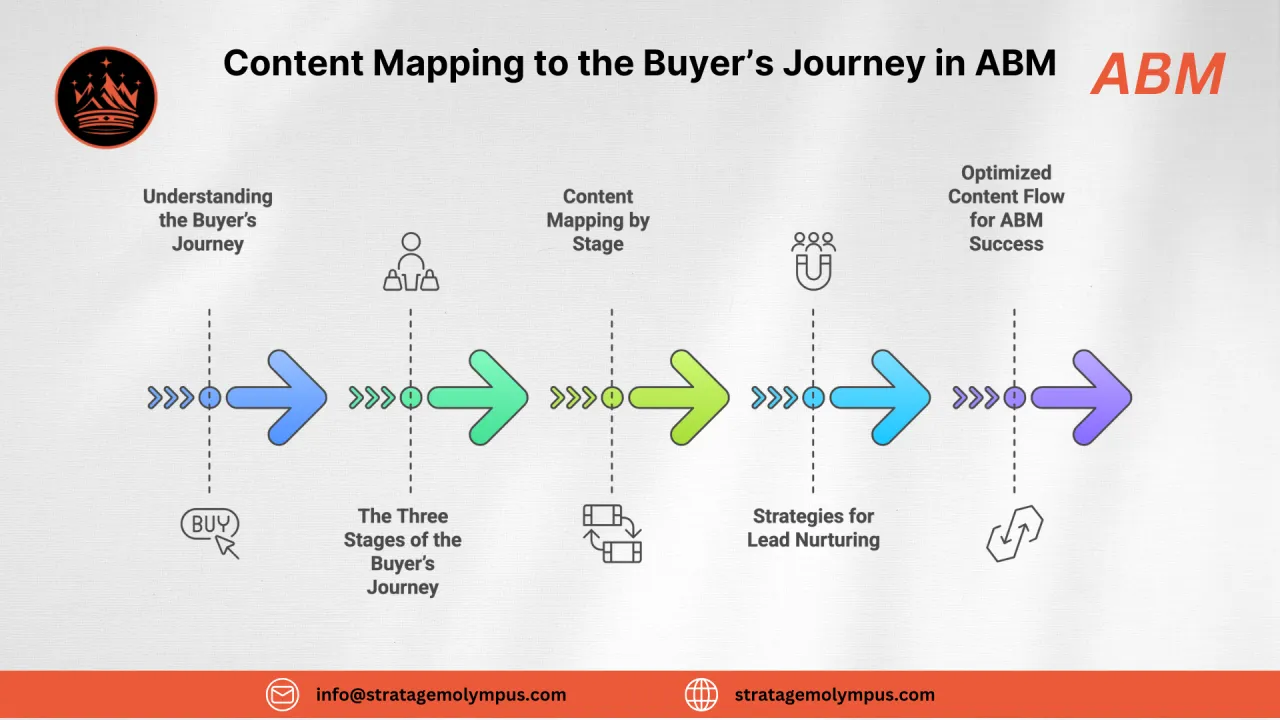
Marketing that doesn’t align with your buyer’s journey is just noise. In industrial engineering & manufacturing, deals don’t close because of generic campaigns—buying decisions are fuelled by content that speaks to the right stakeholders at the right time.
Most manufacturers still push the same content to every prospect—generic brochures, mass email blasts, and poorly executed social media ad campaigns. But decision-makers don’t engage with noise. They engage with solutions tailored to their specific challenges. That’s why ABM isn’t just a strategy—it’s a necessity.
This blog focuses on mapping content to the buyer’s journey, ensuring that every piece of content serves a strategic purpose in nurturing leads, influencing decision-makers, and accelerating sales cycles.
The Industrial B2B Buyer’s Journey
Unlike traditional marketing, where content is designed for a broad audience, ABM content is tailored for specific high-value accounts. Understanding the buyer’s journey helps manufacturers strategically position their messaging to address key pain points and drive engagement at each stage.
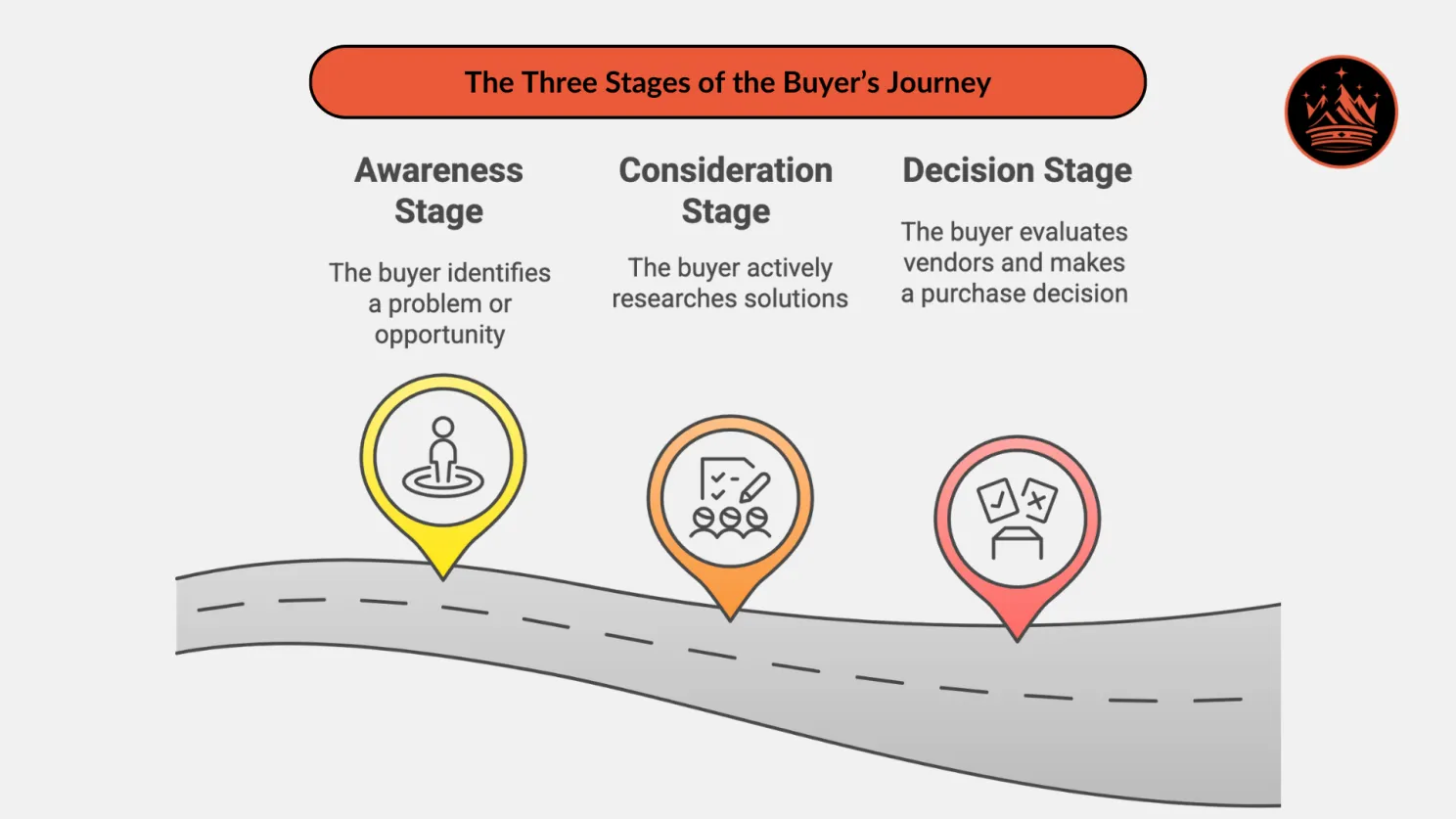
The Three Stages of the Buyer’s Journey
- Awareness Stage – The buyer identifies a problem or opportunity.
- Consideration Stage – The buyer actively researches solutions.
- Decision Stage – The buyer evaluates vendors and makes a purchase decision.
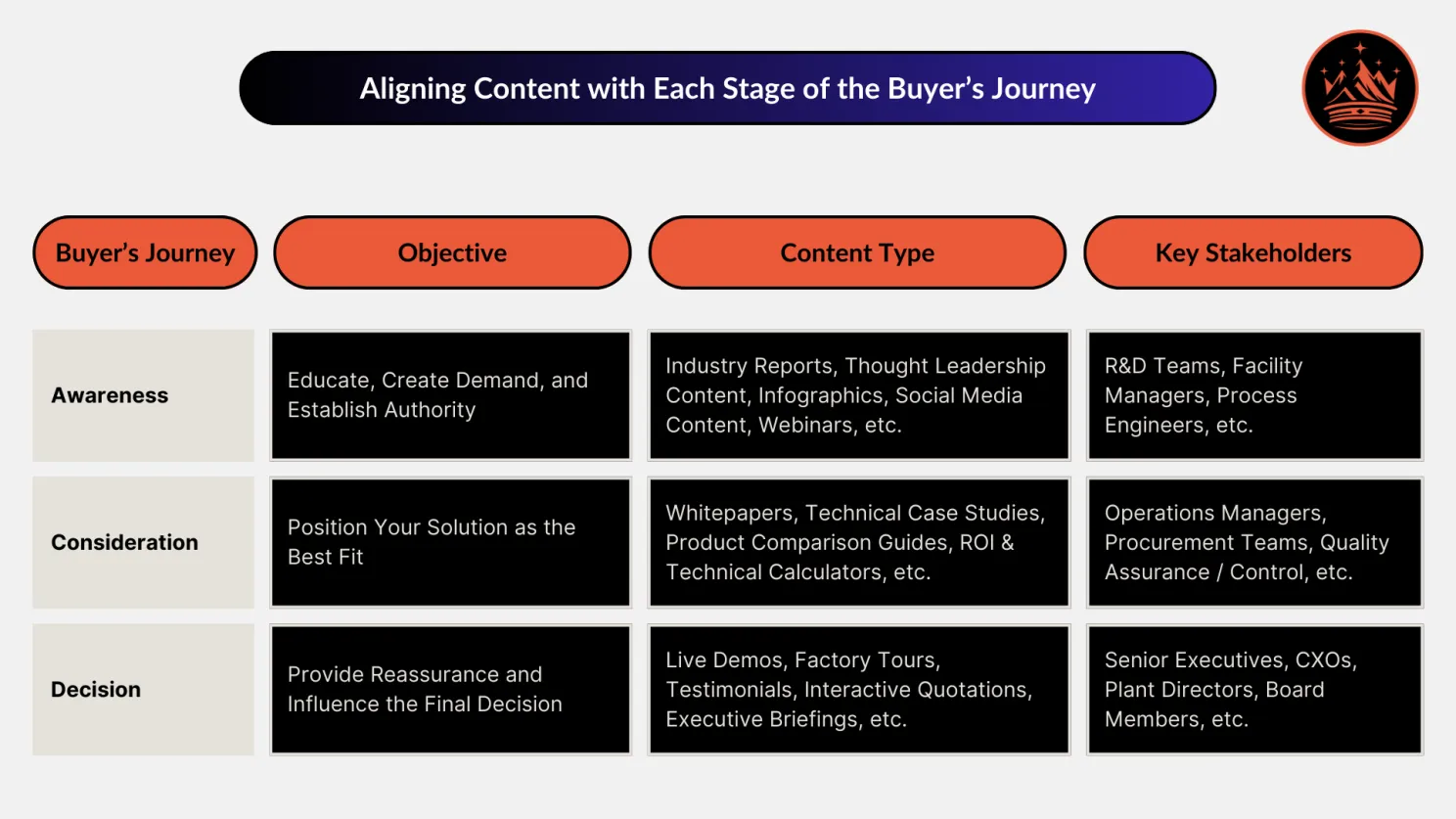
Aligning Content with Each Stage of the Buyer’s Journey
The key to ABM Success lies in aligning content with the unique needs of each stakeholder at different stages of their journey. Below is a strategic framework for mapping content accordingly:
Now, let’s explore how each stage functions in ABM for industrial manufacturing businesses.
Stage 1: Awareness – Educating and Generating Demand
At this stage, buyers realize they have a problem but may not yet be aware of your solution. Your objective is to educate and build credibility while introducing key industry challenges and how you address them.
Content Strategy for the Awareness Stage
- Industry Trend Reports: Position your company as a thought leader by publishing data-driven insights on industry trends.
- Educational Blogs & Articles: Focus on common pain points in manufacturing and potential solutions.
- Social Media Thought Leadership: Share expert insights on platforms like LinkedIn, targeting industry professionals.
- Webinars & Podcasts: Feature industry experts discussing operational challenges and future trends.
- Infographics & Explainer Videos: Visually break down industry challenges and key considerations for process improvements.
Example:
Factory managers in the food industry are under increasing pressure to cut energy costs, yet most industrial ovens waste up to 40% of their heat. An energy-efficient industrial oven manufacturer addresses this problem with a report titled: “Why Food Manufacturers Are Losing Millions in Energy Costs—And How to Fix It with Heat Recovery Technology.” The report highlights industry challenges, regulatory concerns, and innovative solutions, positioning the manufacturer as a trusted authority.
ABM Application: The report is distributed via LinkedIn Campaigns targeted at plant managers and energy efficiency consultants associated with the food industry, sparking early-stage conversations.
Stage 2: Consideration – Positioning Your Solution as the Best Fit
Here, buyers actively evaluate different solutions to address their pain points. The goal is to ensure that your solution stands out by providing in-depth technical insights and proof of value.
Content Strategy for the Consideration Stage
- Technical Whitepapers: Provide in-depth engineering details tailored to specific industries.
- Case Studies: Showcase how your solution helped similar companies overcome challenges.
- Product Comparison Guides: Offer side-by-side comparisons against alternative solutions.
- ROI Calculators & Cost-Savings Analysis: Allow decision-makers to calculate potential efficiency gains.
- Customer Success Stories: Share testimonials from companies that benefited from your technology.
Example:
A packaging machinery manufacturer creates a detailed whitepaper on “The ROI of Switching to Fully Automated Packaging Lines.” The document includes cost-benefit analysis, real-world case studies, and technical insights into how automation improves speed and reduces labour costs.
ABM Application:
- Sent directly to operations managers and procurement teams at pre-qualified food & beverage companies.
- Follow-up emails include a custom ROI calculator, allowing recipients to assess potential savings based on their production volume.
Stage 3: Decision – Sealing the Deal with Reassurance and Confidence
At this stage, buyers need final assurances before making a purchase decision. This is where personalized engagement and strong value reinforcement come into play.
Content Strategy for the Decision Stage
- Live Product Demos & Factory Tours: Offer on-site or virtual tours demonstrating real-world applications of your technology.
- Interactive Sales Proposals & Quotes: Provide customized pricing, implementation timelines, and tailored features.
- Executive Briefings & One-on-One Consultations: Senior executives engage directly with decision-makers to address final concerns.
- Customer Testimonials & Video Case Studies: Show proven success stories with measurable impact.
Example:
A precision machining solutions provider invites C-level executives from automotive manufacturing companies to an exclusive factory tour showcasing their latest high-precision CNC machines. They not only highlight the advanced features and capabilities of these machines, but also provide a tailored cost-benefit presentation demonstrating how their machines reduce scrap rates and improve production speeds.
ABM Application:
- Follow-ups include personalized implementation plans based on the prospect’s facility size.
- The sales team sends a custom video walkthrough explaining how the machines integrate with their existing production setup.
Strategies for Nurturing Leads Through Targeted Content
Effective ABM Content isn’t just about what you create, but how you deliver it. Here are key strategies for ensuring content engages the right decision-makers throughout their journey.
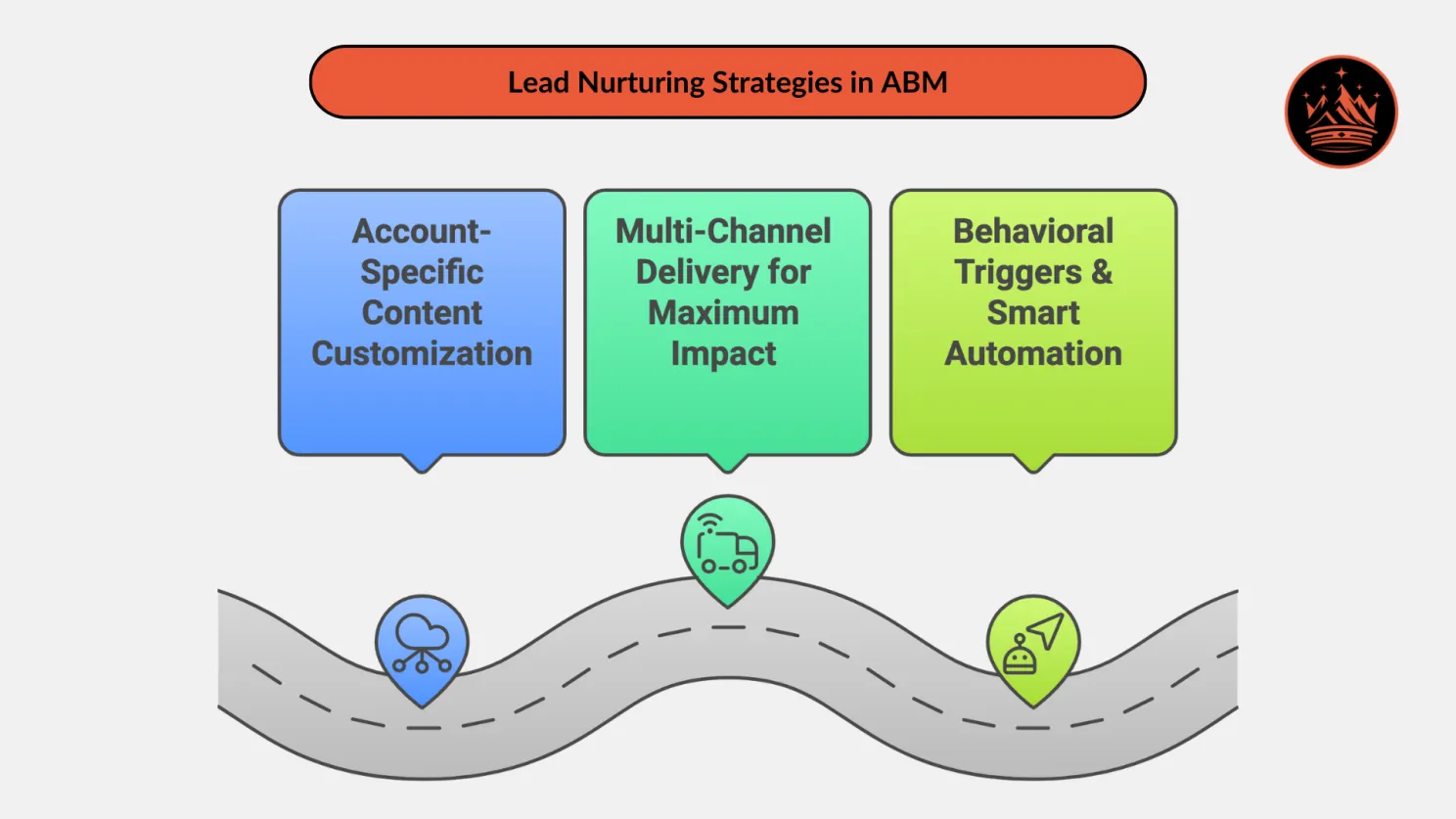
1. Account-Specific Content Customization
- Modify whitepapers and case studies to reflect the target company’s industry, size, and challenges.
- Instead of using generic presentations, tailor sales decks, product comparisons, and reports with industry-specific insights for each target account.
Example: A compressor manufacturer creates two versions of their product performance report—one emphasizing hygienic air compression benefits for a food processing plant and another focusing on high-pressure reliability for a chemical plant. This ensures each prospect receives information relevant to their unique needs.
2. Multi-Channel Delivery for Maximum Impact
- LinkedIn & Email Campaigns: Deliver targeted content to specific job titles at key accounts.
- Direct Mail with QR Code Integration: Send physical product samples or industry reports with scannable QR codes linking to personalized video demos.
- Retargeting Campaigns: Use behaviour data to deliver next-step content based on what stakeholders have previously engaged with.
3. Behavioural Triggers & Smart Automation
- Deploy automated email sequences that deliver the next logical piece of content based on a lead’s actions.
- Use intent data tracking to trigger personalized outreach when an account shows buying signals, such as multiple whitepaper downloads or repeat visits to a pricing page.
Key Takeaways
✅ Stop Generic Marketing: Your prospects don’t need another brochure that doesn’t speak to their challenges. Make every piece of content specific to the target industry, their challenges, and relevant stakeholders.
✅ Content Must Align with the Buyer’s Needs: Each stage of the buyer’s journey requires different content formats and levels of detail.
✅ Engage Decision-Makers Where They Are: LinkedIn, Email, Direct Mail, and Behavioural Triggers ensure your content lands where it matters.
✅ Nurture Smartly, Not Loudly: Use automation, retargeting, and buying signals to deliver the next right content piece—not just any content.
For industrial engineering manufacturers, content isn’t just a marketing tool—it’s the fuel that powers high-value sales conversations. By strategically mapping content to the buyer’s journey, ABM ensures that every interaction is meaningful, educational, and impactful.
-1.png)
-1.png)