
1️⃣ AI + Automation = Redefining ABM for Industrial Manufacturers
“AI is not the future of marketing. It is the present.”
In the industrial engineering and manufacturing domain, where sales cycles are long, buying committees are complex, and margins are non-negotiable, traditional ABM can only take you so far. It’s time to usher in a new era. One where Artificial Intelligence (AI) and Automation drive real-time decisions, hyper-personalization, and scalable precision.
Account-Based Marketing (ABM) is already a proven strategy in this space. But when you embed AI and automation into its core, ABM transforms from a labor-intensive tactic into a predictive, adaptive, and self-optimizing growth engine. This is not about replacing humans; this is about empowering them to operate at industrial-grade efficiency.
Why This Matters Now?
The industrial buyer is evolving fast. Gone are the days when relationships and brochures sealed the deal. Today’s buyers:
- Spend 67% of their buying journey researching independently before contacting sales
- Expect real-time answers, not 7-day response times
- Engage across multiple channels from LinkedIn to spec sheet downloads to webinars
- Prefer relevance over repetition and value over volume
And yet, most industrial marketing and sales teams are still relying on manual list building, batch-and-blast campaigns, and “hope-based” outreach sequences.
AI and automation change this.
- They detect intent signals before your competitors even know the buyer exists.
- They personalize messaging based on firmographics, technographics, and behavior.
- They trigger outreach sequences the moment a buying signal is detected.
- They analyze every interaction, enabling your team to improve continuously.
B2B marketers using AI report significantly improved ROI and marketing efficiency.
And it’s not just about ROI. For industrial manufacturers, integrating AI into ABM means:
- Less time chasing cold accounts, more time engaging warm ones
- Fewer missed opportunities, more converted deals
- Reduced CAC, shorter sales cycles, and larger deal sizes
This article will guide you through the what, why, and how of AI-powered ABM in the industrial sector, with real-world case studies, frameworks, and technology stacks that prove:
The future of industrial growth is not just account-based. It’s also AI-enhanced and automation-driven.
2️⃣ Key Benefits of AI-Powered ABM in Industrial Manufacturing
When done right, Account-Based Marketing already offers industrial firms a strategic edge - tighter targeting, higher engagement, and better ROI. But when you integrate Artificial Intelligence (AI) and Automation, ABM evolves from proactive to predictive. From targeted to truly intelligent.
Here’s how AI-enhanced ABM transforms outcomes across the industrial go-to-market funnel:
⚙️ 1. Predictive Account Targeting That Uncovers Demand Early
Traditionally, account selection in ABM depends on historical performance, firmographics, and guesswork. With AI, you gain:
- Predictive Scoring to prioritize accounts most likely to convert
- Lookalike Modeling to identify new ICP-fit accounts based on behavior and performance
- Real-Time Buying Signals that surface accounts researching similar solutions
🧠 AI doesn’t just tell you who to target, it tells you who’s ready to buy, even before they raise their hand.
✅ Example: AI tools like 6sense and Demandbase aggregate intent data, web behavior, and CRM activity to surface “in-market” industrial accounts, enabling sales to engage weeks ahead of competitors.
🔍 2. Intent Signal Analysis That Sharpens Timing
The success of ABM hinges on engaging the right account at the right time. AI tools analyze:
- Engagement heatmaps across buying committees
- Behavioral shifts (Ex: a sudden spike in interactive quote visits)
- Cross-channel activity, including email opens, ad clicks, and webinar attendance
AI transforms these data points into actionable buying stage predictions, so your team reaches out when intent is peaking, not when it’s already cold.
📈 Companies using AI for intent analysis see significantly higher conversion rates compared to those relying on traditional lead scoring models.
✉️ 3. Hyper-Personalization at Scale
Industrial decision-makers don’t respond to generic outreach. They want relevance, fast.
With AI, you can:
- Personalize emails, landing pages, and product recommendations based on firmographic, technographic, and behavioral data
- Dynamically adjust messaging based on buyer role (Ex: engineer vs. procurement)
- Serve industry-specific case studies and whitepapers through automated content engines
🎯 What once took a marketing team 2 weeks now takes an AI engine minutes, with 10x the precision.
📲 4. Automated Multi-Channel Orchestration
The modern industrial buyer journey spans email, LinkedIn, webinars, website chats, industry forums, and even YouTube.
AI-powered ABM platforms orchestrate campaigns across:
- Email sequences triggered by behavior
- LinkedIn and programmatic ad delivery based on ICP-fit scoring
- Chatbot engagement for on-site visitors from target accounts
- Sales alerts that notify reps in real-time when key accounts spike in activity
🤖 Tools like HubSpot ABM, Apollo.io, RollWorks, and Salesforce Einstein enable full-funnel orchestration without manual heavy lifting.
📊 5. Continuous Learning & Campaign Optimization
With AI, your ABM campaigns become smarter with every interaction. Over time, AI systems learn:
- Which messages resonate with each industry vertical
- Which channels perform best per buying stage
- Which engagement patterns correlate with deal acceleration
This means your campaigns optimize themselves, reducing human error and increasing performance over time.
🧪 Think of it as an always-on experiment, with AI constantly refining your strategy behind the scenes.
🧠 Bonus: Smarter Resource Allocation = Higher ROI
AI insights help teams:
- Stop wasting time on cold accounts
- Double down on accounts with high LTV potential
- Allocate ad budgets dynamically to the best-performing segments
💰 AI-powered marketing teams report significant reductions in customer acquisition cost (CAC).
✅ TL;DR: AI-Powered ABM Helps You…
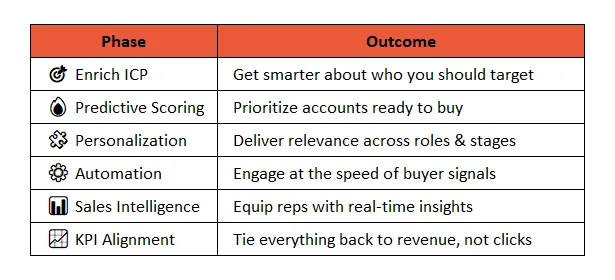
The industrial buying journey is complex. AI-powered ABM makes it navigable and profitable.
3️⃣ AI-Driven ABM Framework for Industrial Manufacturing
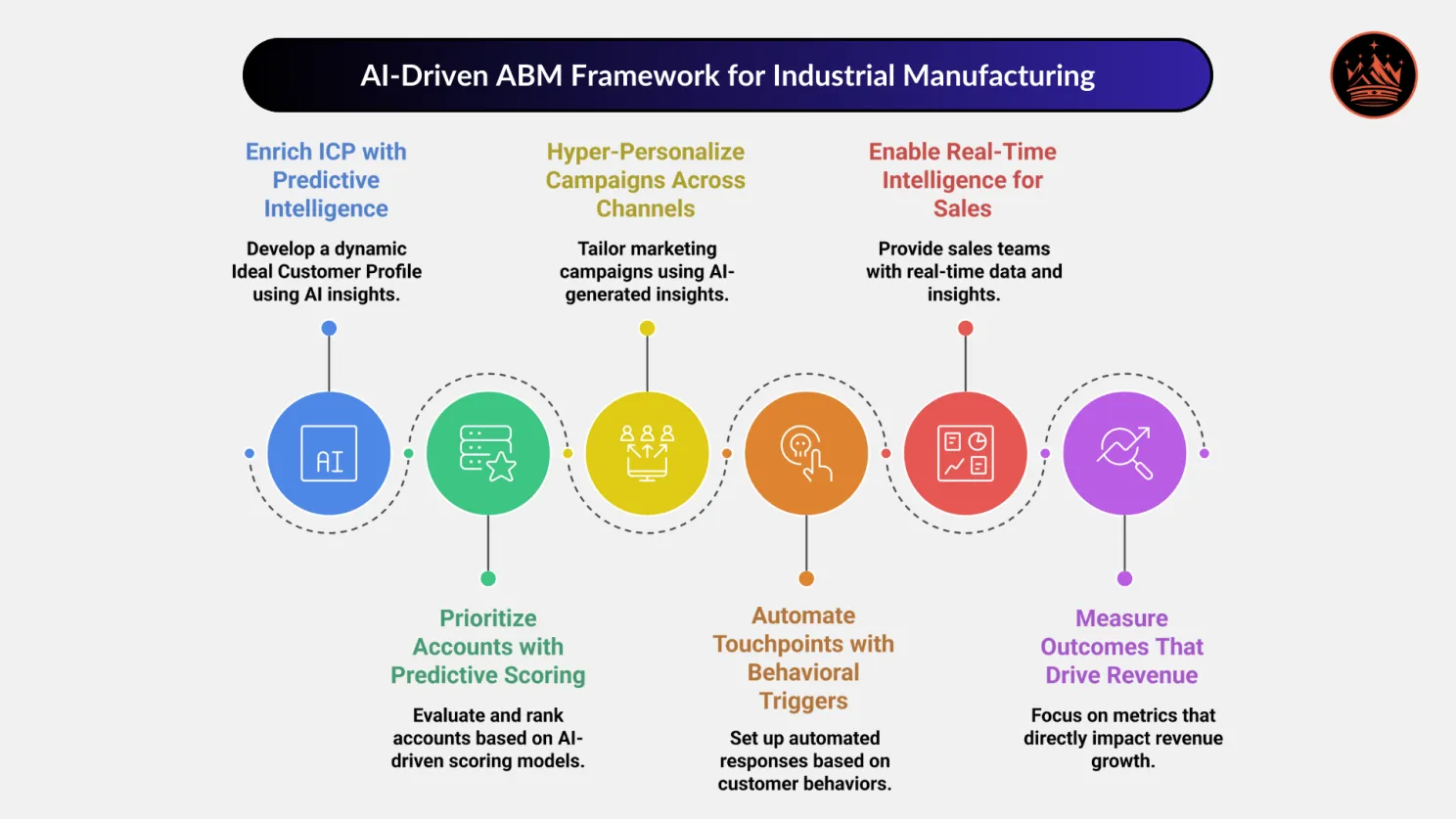
Integrating AI into ABM isn’t about adding more tools to your tech stack. It’s about building a self-optimizing, insight-rich system that aligns your go-to-market engine around buying signals, not just buyer personas. Below is a step-wise framework purpose-built for industrial engineering and manufacturing businesses dealing with long sales cycles, complex buying committees, and high-value solutions.
🔍 Step 1: Enrich ICP with Predictive Intelligence
Traditional ICP development leans heavily on static firmographics like industry, size, and location. With AI, your ICP evolves dynamically.
Action Points:
- Combine firmographic, technographic, and intent signals
- Feed in historical engagement data and win / loss analysis
- Leverage tools like 6sense, Lusha, or Apollo.io to identify lookalike accounts
🧠 Your ICP becomes a living model, adjusting as buying behavior changes.
🧭 Step 2: Prioritize Accounts with Predictive Scoring
Not all ICP-fit accounts are created equal. AI scoring models evaluate:
- Real-time buyer activity (content engagement, ad clicks)
- Historical account performance
- Team decision velocity and multi-threaded engagement
Action Points:
- Deploy predictive scoring engines within platforms like Demandbase One or HubSpot ABM
- Create “hot,” “warm,” and “nurture” tiers to align resource intensity
📌 Score not just on fit, but on likelihood to engage and convert.
🎯 Step 3: Hyper-Personalize Campaigns Across Channels
AI-generated insights enable us to incorporate:
- Role-based messaging (Example: ops maneger vs. engineer vs. procurement)
- Industry & application-specific content
- Buying stage–specific CTAs
Action Points:
- Build dynamic content blocks within email and landing pages (HubSpot Smart Content / mutinyhq.com)
- Use programmatic ad platforms like RollWorks for intent-based ad delivery
✉️ From email subject lines to whitepaper titles - everything gets tailored.
🤖 Step 4: Automate Touchpoints with Behavioral Triggers
ABM becomes intelligent only when it’s responsive. AI enables you to:
- Trigger email sequences when an account hits your interactive quote page
- Launch retargeting ads when engagement drops
- Send chatbot prompts when a buyer revisits specifications or other technical content
Action Points:
- Define key behaviors that signal intent: site revisit, demo page view, interactive quote page views, email re-opens, etc.
- Configure engagement flows using marketing automation platforms like VBOUT, Salesforce Pardot, or Marketo Engage
⏱ You don’t follow up based on guesswork. You follow up based on signals.
📊 Step 5: Enable Real-Time Intelligence for Sales
AI-powered dashboards give your sales team:
- Alerts on engagement surges
- Conversation-ready insights (Example: content viewed, current line of equipment installed, upcoming compliance cycles, etc.)
- Predictive Win-Probability models
Action Points:
- Integrate tools like HubSpot Breeze Intelligence, MadKudu for real-time insights
- Sync buyer insights directly into CRM records and outreach cadences
🚀 Sales enters conversations with full account intelligence, before the first hello.
📏 Step 6: Measure Outcomes That Drive Revenue
Shift away from vanity metrics and focus on:
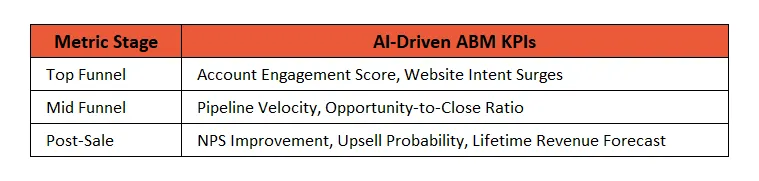
Action Points:
- Build ABM dashboards using Tableau, HubSpot, or Segment
- Set benchmarks across funnel stages, not just form-fills
📈 AI helps you move from campaign performance to revenue impact visibility.
🧠 TL;DR: A Purpose-Built AI-Driven ABM Framework for Industrial Engineering & Manufacturing
The result? ABM that thinks, adapts, and scales like your best-performing rep, automated.
4️⃣ AI in ABM: Industrial Use Cases & Success Stories
While AI-powered ABM may seem like the domain of tech titans, industrial manufacturing leaders are already deploying it, and the results are redefining what’s possible. Below are real-world success stories that exemplify how AI and automation are transforming marketing in capital-intensive, industrial engineering-driven sectors.
📍 Case Study 1: Industrial Automation OEM | Predictive Targeting + Personalization
Challenge:
The company needed to identify which of its enterprise prospects were actively researching industrial automation solutions, before sales ever spoke to them.
Solution:
Using 6sense’s predictive analytics, they combined behavioral signals (search terms, content consumption, competitor interactions) with technographic filters to prioritize accounts showing early buying intent. This intent data informed:
- Sales outreach cadences
- LinkedIn ads targeted at decision-makers
- Custom demo journeys based on target industry segments
Results:
- 📈 Increased pipeline contribution from marketing by 30%
- 🔍 Account-level targeting accuracy improved by ~60%
- 🧠 Sales-reported conversion quality improved significantly, according to internal CRM benchmarks
📍 Case Study 2: Global Industrial-Tech Leader | AI-Led ABM Orchestration
Challenge:
With a complex product portfolio and dozens of buying personas across industrial verticals, the company needed a unified, intelligent ABM system.
Solution:
They deployed Demandbase One to:
- Centralize account intelligence
- Orchestrate personalized multichannel outreach
- Score accounts in real-time using AI to predict buying readiness
Execution Highlights:
- Sales were instantly alerted when an account hit “hot” intent thresholds
- Ad creatives dynamically shifted based on segment behavior (Example: OEMs vs. infrastructure buyers)
- Customer Success follow-ups were automated post-sale to ensure engagement didn’t stop at the contract
Results:
- 📊 4X increase in engaged buying committee members per account
- 🕒 2X faster average sales cycle
- 💡 Greater visibility into which campaigns influenced revenue
📍 Case Study 3: Mid-Sized Industrial Equipment Manufacturer
Challenge:
A specialized manufacturer of hydraulic systems struggled with poor response rates and sales wasting time on cold, unqualified accounts.
Solution:
Partnered with an industrial ABM agency to layer intent-triggered automation on top of their ABM play:
- AI scored accounts dynamically based on Bombora buyer intent data
- Campaigns only triggered when an account showed research behavior
- Personalization scaled using smart email templates & automated nurture journeys
Results:
- 🎯 3 new OEM contracts in 4 months
- 💰 $290K in new business generated
- 📈 Dramatic increase in content engagement and email open rates
📍 Case Study 4: Hexagon | Real-Time Buyer Signals for GTM Teams
Challenge:
Hexagon’s business units were running siloed ABM campaigns, often unknowingly targeting the same accounts with conflicting messages.
Solution:
They implemented a centralized AI-powered dashboard through Demandbase, giving every GTM team (sales, marketing, customer success) access to:
- Shared account prioritization models
- Real-time account engagement alerts
- Suppression logic to avoid duplicate touchpoints
Results:
- 💬 60%+ engagement across target accounts
- 🧩 278% higher CTR on personalized ads
- 🛠️ Eliminated internal outreach conflicts and campaign redundancies
Source: Demandbase
💡 What These Stories Reveal
These success stories confirm: AI and automation aren’t optional for ABM success in industrial markets, they’re essential. Whether you’re managing a few dozen key accounts or thousands, AI-powered ABM frameworks scale your efforts with precision, efficiency, and measurable impact.
5️⃣ AI & Automation Tech Stack for Industrial ABM
Artificial Intelligence doesn’t work in isolation, it works through orchestration. To harness the full potential of AI in ABM, industrial sales & marketing teams need a well-integrated, cross-functional tech stack that brings data, automation, personalization, and insights together in real time.
Below is a breakdown of the core tech layers, along with leading platforms that empower AI-powered ABM at scale.
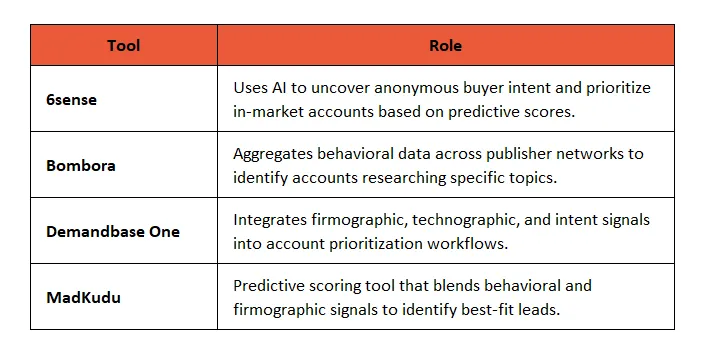
🧠 1. Intent Data & Predictive Scoring
🔍 Why It Matters:
These tools help identify which accounts are researching solutions like yours, before they ever hit your site. For industrial manufacturers with long sales cycles, this is the difference between chasing cold leads and intercepting warm, high-intent buyers.
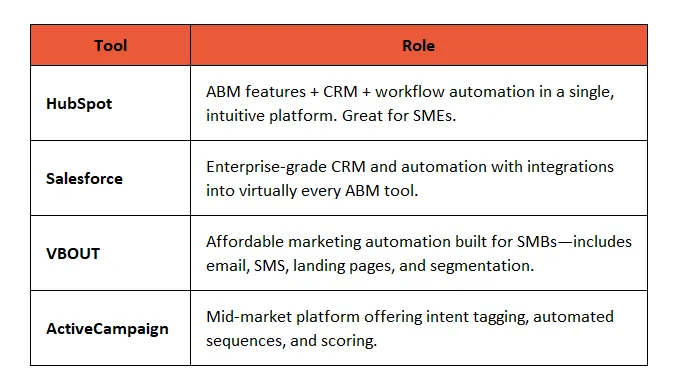
⚙️ 2. Marketing Automation & CRM
🔍 Why It Matters:
This layer allows you to nurture accounts at scale, trigger sequences based on behavior, and maintain a single source of truth across teams.
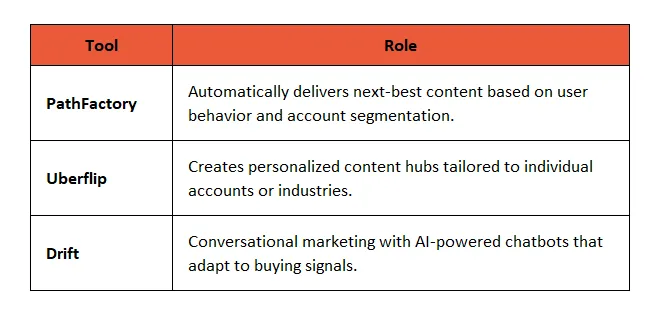
📦 3. Content Personalization & Delivery
🔍 Why It Matters:
In complex industrial buying journeys, one-size-fits-all content falls flat. These tools deliver relevant, contextual content to every stakeholder at every stage.
🧩 4. AI-Powered ABM Orchestration Platforms
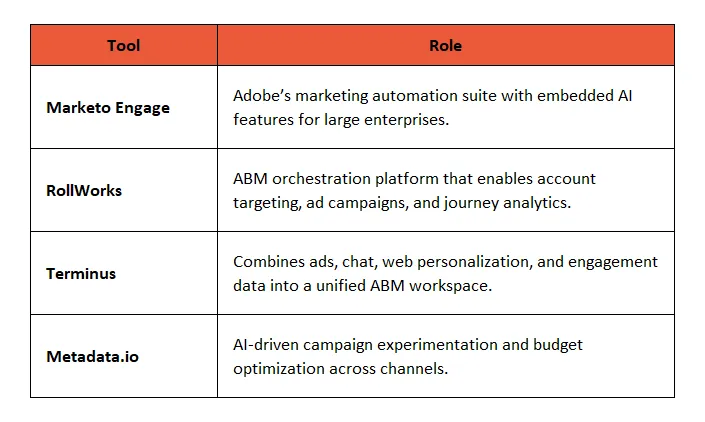
🔍 Why It Matters:
These tools sit at the center of your ABM engine, connecting insights, triggering personalized campaigns, and surfacing analytics in one view.
📈 5. Analytics & Feedback Loops
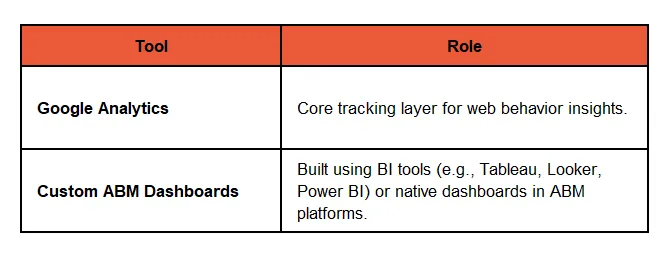
🔍 Why It Matters:
ABM is only as good as your ability to measure it. These tools enable you to evaluate engagement, progression, and revenue attribution, not just vanity metrics.
⚙️ Pro Tip for Industrial SMEs
You don’t need a PhD in data science to deploy AI in your ABM stack.
💡 Start with 1–2 layers (e.g., HubSpot + Bombora), integrate gradually, and scale as your maturity evolves.
6️⃣ Implementation Challenges & Best Practices for Industrial ABM Teams
Adopting AI and automation in ABM can feel like jumping into a labyrinth—especially for industrial manufacturing firms with rigid systems, siloed teams, and legacy infrastructure. While the rewards are significant, the road to adoption requires strategic clarity and operational discipline.
Below, we break down the most common challenges along with proven best practices to help industrial teams not just implement AI—but succeed with it.
⚠️ Challenge 1: Disconnected Data Across Systems
The Problem:
Industrial companies often juggle multiple CRMs, ERPs, and marketing tools—none of which “talk to each other.” This creates fragmented account views, duplication of effort, and confusion around who owns what stage of the buyer journey.
The Solution:
✅ Unify your GTM tech stack. Choose platforms that integrate seamlessly across CRM, marketing automation, and ABM layers.
Best Practice:
- Implement a Customer Data Platform (CDP) to create a unified account profile.
- Use native integrations (e.g., HubSpot + 6sense, Salesforce + Demandbase) to connect marketing and sales insights.
⚠️ Challenge 2: Low AI Maturity in the Organization
The Problem:
Many industrial teams aren’t equipped to understand or trust AI-based insights. Sales reps might ignore lead scores; marketing may be wary of handing over campaign control to automation.
The Solution:
✅ Start with guided AI use cases like lead scoring, account prioritization, and intent-triggered email sequences.
Best Practice:
- Offer internal training workshops explaining how AI-generated insights are derived.
- Start with AI-assisted (not fully autonomous) campaigns to build trust in automation outcomes.
⚠️ Challenge 3: Lack of Content Personalization Infrastructure
The Problem:
Industrial firms often lack content frameworks that support dynamic personalization, making it difficult to scale tailored experiences across different segments and buyer personas.
The Solution:
✅ Create modular, persona-aligned content templates that AI systems can pull from and personalize at scale.
Best Practice:
- Build a centralized content library mapped to different funnel stages, industries, and job roles.
- Use dynamic content tokens in emails and landing pages to personalize based on company size, industry, or product interest.
⚠️ Challenge 4: Sales-Marketing Misalignment on AI-Driven Prioritization
The Problem:
If sales and marketing aren’t aligned on how accounts are prioritized by AI, the system’s recommendations can be ignored, misinterpreted, or misused, negating its value.
The Solution:
✅ Create a shared account scoring model and agree on what constitutes “in-market” behavior.
Best Practice:
- Define Service Level Agreements (SLAs) between teams on how to respond to AI signals (Example: response time to high-intent accounts).
- Use joint ABM dashboards to review intent surges and campaign influence weekly.
⚠️ Challenge 5: Resistance to Process Change
The Problem:
Long-standing teams are often resistant to re-engineering workflows around new tools, especially when the benefits aren’t immediately visible.
The Solution:
✅ Begin with a pilot ABM program, prove early ROI, then scale with success stories internally.
Best Practice:
- Run a 3-month ABM Pilot on a small segment of target accounts.
- Document improvements in deal velocity, engagement, and pipeline attribution.
- Use internal case studies to build executive and departmental buy-in.
✅ Recap Table: From Challenge to Best Practice
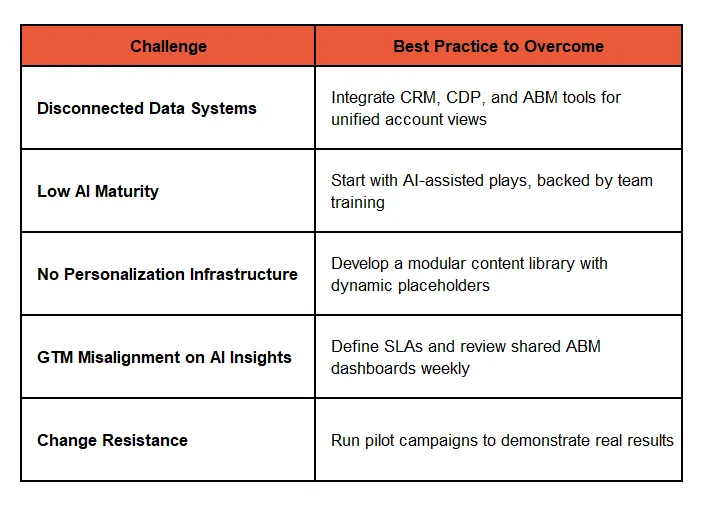
Bottom Line: Implementing AI and automation in industrial ABM isn’t about flipping a switch. It’s about engineering a scalable, cross-functional system built on data, trust, and shared goals.
When done right, it becomes the engine of predictable growth, not just for marketing but for every revenue-generating function in your organization.
7️⃣ Key Takeaways
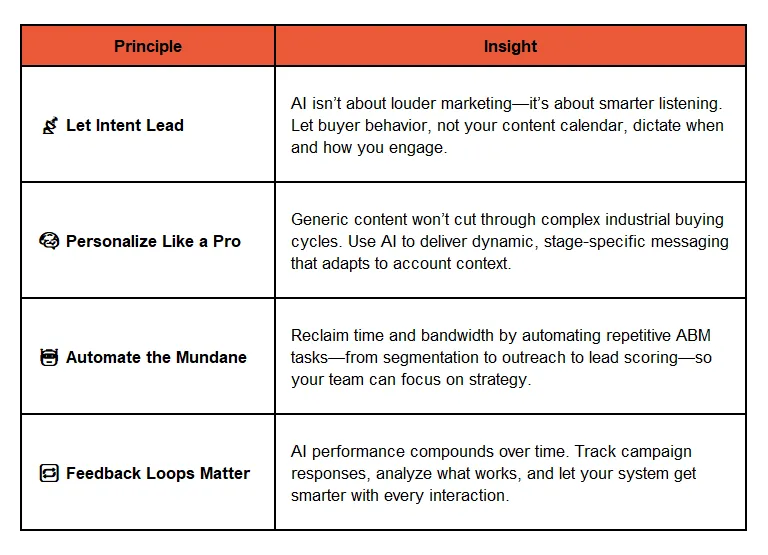
💡 ABM success in industrial markets is no longer about doing more, it’s about doing what matters most, faster and smarter.
8️⃣ Final Thoughts - AI Is the Engine, ABM Is the Strategy
AI alone can’t win deals. ABM without AI can’t scale.
Together, they form a modern industrial revenue engine, designed for precision targeting, relevant engagement, and repeatable growth across long, complex sales cycles.
-1.png)
-1.png)