
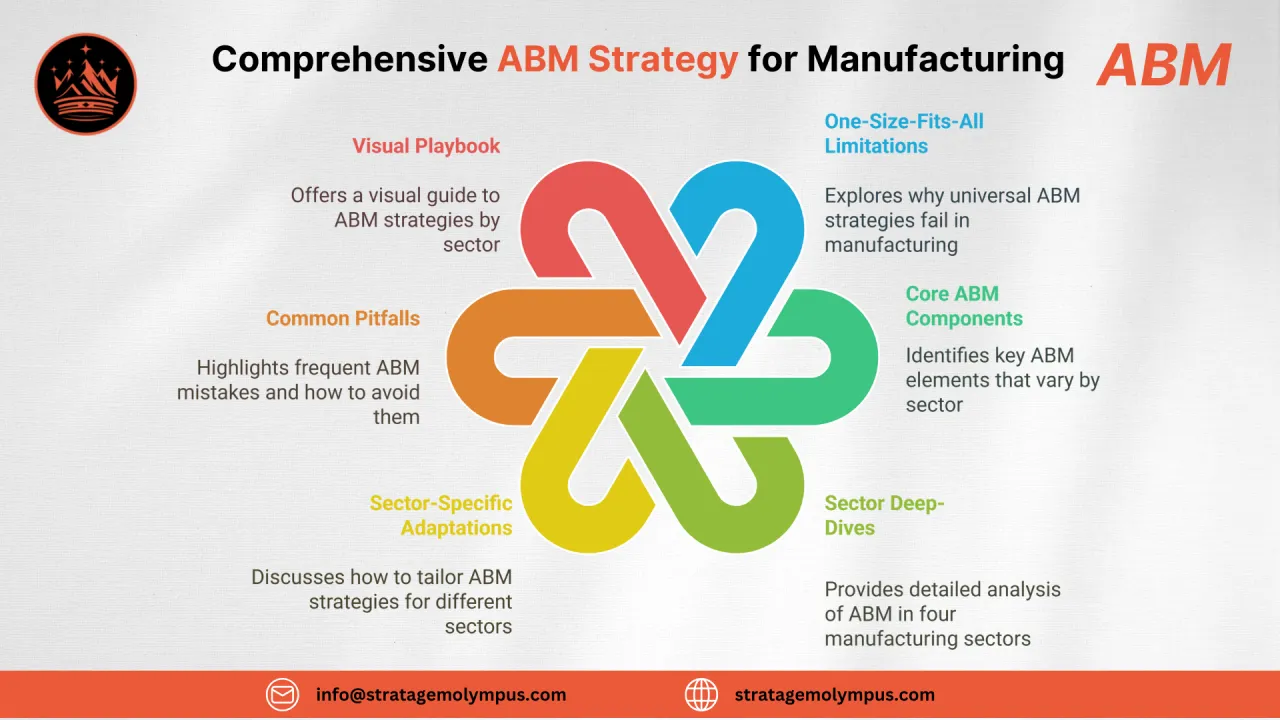
Why One-Size-Fits-All ABM Doesn’t Work in Industrial Manufacturing
Account-Based Marketing (ABM) has redefined how industrial manufacturers go to market, enabling smarter targeting, personalized outreach, and measurable sales alignment. But here’s the catch: not all manufacturing sectors operate the same, and treating them like they do is a recipe for underwhelming results.
The world of industrial manufacturing is vast, fragmented, and full of nuance. From automotive component suppliers juggling multi-tiered vendor qualification programs, to food processing equipment manufacturers complying with strict hygiene and traceability regulations, each vertical comes with its own ecosystem of pain points, buyer personas, and decision-making rituals.
What works for an OEM in the automotive space may completely flop when applied to a plant manager evaluating food-grade machinery. The procurement triggers, sales cycles, content formats, and compliance sensitivities are fundamentally different, and ABM that fails to adapt will fail to convert.
This is why the age of generic ABM is over. The future lies in localized, sector-aware ABM strategies that:
- Speak the technical and regulatory language of the target sector
- Mirror the buying psychology of its stakeholders
- Deliver value-aligned content mapped to industry-specific pain points
In this blog, we’ll break down exactly how to do that. You’ll explore four manufacturing sectors, Automotive, Industrial Equipment, Food & Beverage Processing Equipment, and Electronics, and learn how to tailor your ABM playbook for each.
Because if you’re selling into industrial markets, ABM can’t be just about targeting accounts, it must be about understanding industries.
Core ABM Components That Vary Across Sectors
One of the biggest missteps in industrial ABM? Assuming that all manufacturing verticals respond to the same messaging, cadence, and content. In reality, the building blocks of ABM, targeting, messaging, timing, and delivery. Must flex based on sector-specific nuances.
Let’s break down five ABM components that dramatically shift depending on the industry you’re targeting:
💼 Buying Committee Dynamics
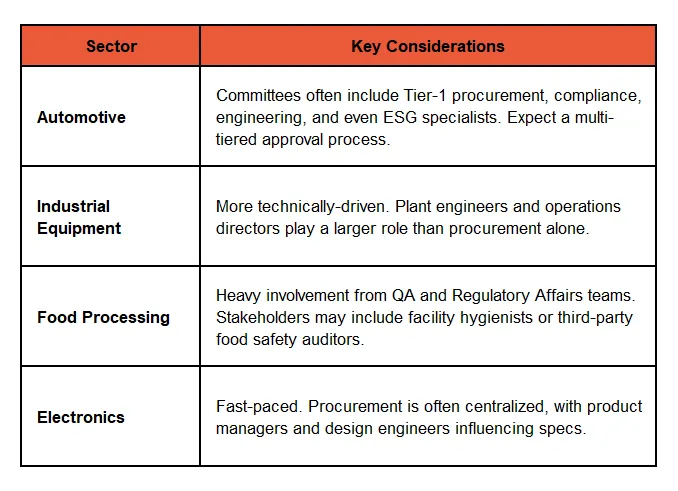
💡 ABM Tip: Tailor your nurturing strategy to cycle speed. Long cycles need education-first cadences; fast cycles require immediate value demonstration.
🧾 Compliance & Regulation
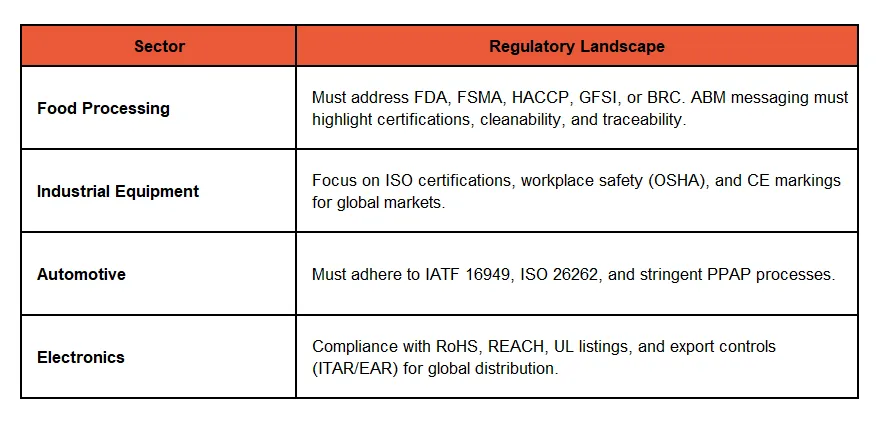
💡 ABM Tip: Build sector-specific content libraries showcasing compliance alignment, it’s often a dealbreaker.
🔥 Pain Points & Triggers
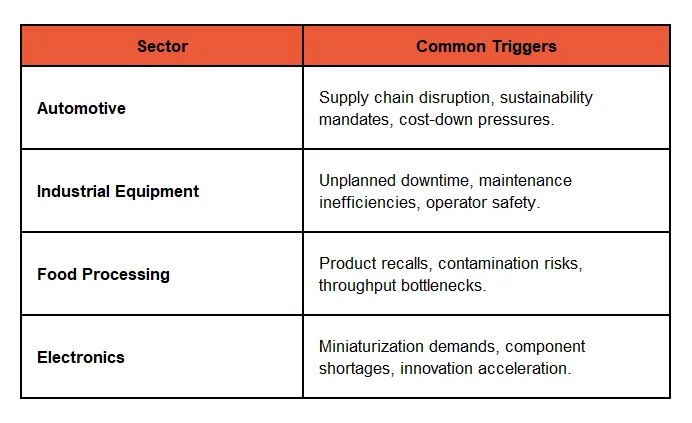
💡 ABM Tip: Anchor your value propositions around trigger events. Example: Maintenance inefficiencies? Push content on preventive / predictive maintenance.
🔁 Post-Sale Lifecycle Complexity
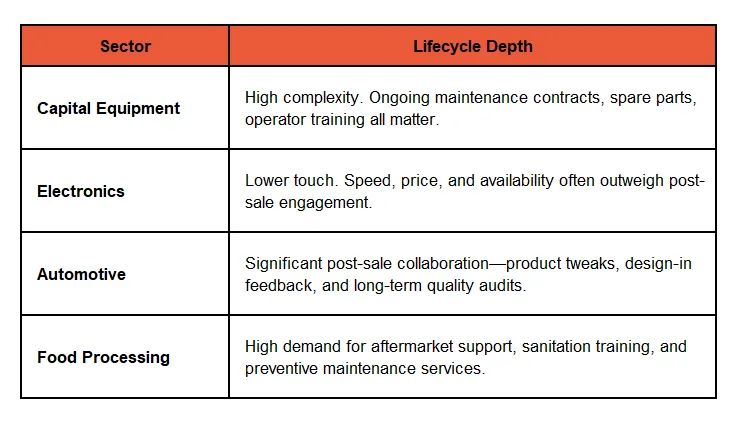
💡 ABM Tip: Don’t stop after the sale. Tailor ABM nurture tracks to reflect post-sale expectations unique to each sector.
Sector Deep-Dives - ABM Customization in 3 Industrial Manufacturing Verticals
ABM isn’t a plug-and-play system. In industrial manufacturing, every vertical comes with its own set of rules, pain points, compliance hurdles, and buyer behaviors. To truly resonate, your ABM approach needs to speak the language of the industry and its decision-makers.
Below, we dissect three core verticals and explore how customized ABM strategies help penetrate, influence, and convert high-value accounts.
⚙️ 1. Automotive Components & Systems
ABM Challenges:
- Global supply chains and tiered vendor structures mean decisions often pass through multiple procurement layers (OEMs → Tier 1s → Tier 2s).
- Buyers are under relentless pressure for cost-down initiatives, value engineering, and zero-defect delivery standards.
- Strict qualification processes can stall outreach, if not pre-aligned with engineering standards or validation protocols.
ABM Strategy Highlights:
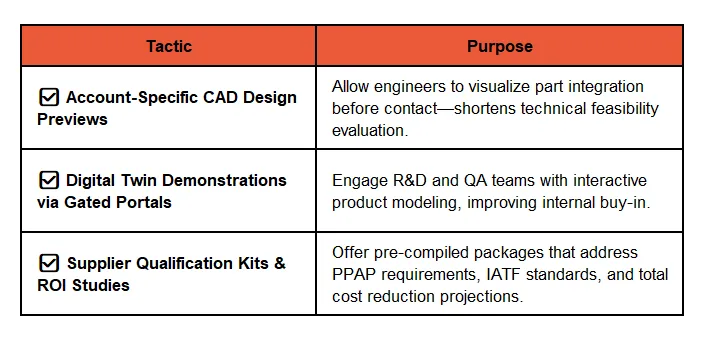
💡 In automotive ABM, you’re not selling a product, you’re selling a validated process that integrates into a regulated supply chain.
🏭 2. Industrial Equipment & Machinery
ABM Challenges:
- Long sales cycles due to high CAPEX, multiple technical approvals, and pilot trials.
- Target buyers range from plant managers and maintenance heads to executive leadership, each requiring different value propositions.
- Purchases are often deferred unless there’s a clear ROI case or compliance push.
ABM Strategy Highlights:
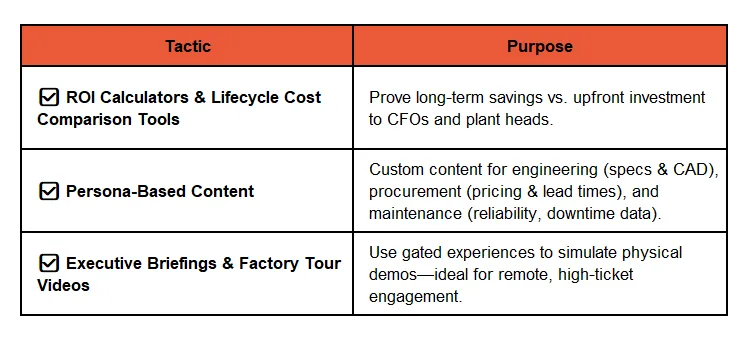
💡 Industrial buyers don’t just want information, they want confidence that your solution will work for years, not months.
🥫 3. Food & Beverage Processing Equipment Manufacturing
ABM Challenges:
- Industry is highly regulated, buyers must navigate HACCP, FDA, FSMA, GFSI, and more.
- Plant Ops teams prioritize sanitation, throughput, and maintenance ease.
- Even minor downtime has high financial penalties, reliability is everything.
ABM Strategy Highlights:
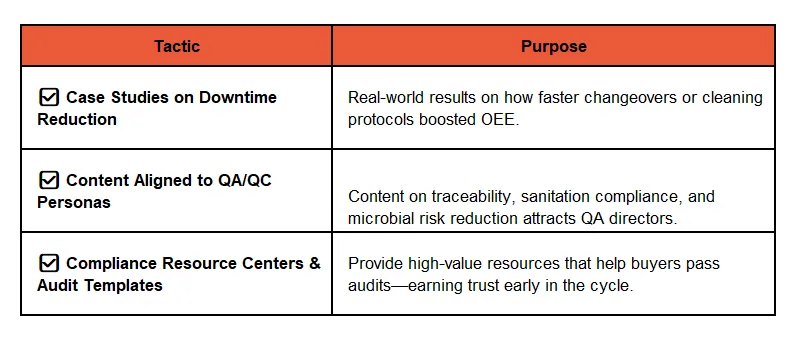
💡 If you can help food processors sleep better during inspections, you’ve already won half the battle.
How to Adapt Your ABM Strategy by Sector
ABM only works when it feels bespoke and that customization must go beyond targeting the right accounts. To achieve real traction, industrial manufacturers must adapt the way they communicate, engage, and support prospects based on sector-specific dynamics.
This means rethinking content formats, engagement channels, sales enablement assets, and outreach rhythms, not just messaging.
Here’s how to refine your ABM execution strategy by vertical:
📝 Content Format: Speak Their Language, Visually and Technically
Not all stakeholders consume content the same way. The format you choose should align with the persona’s role and the sector’s expectations.
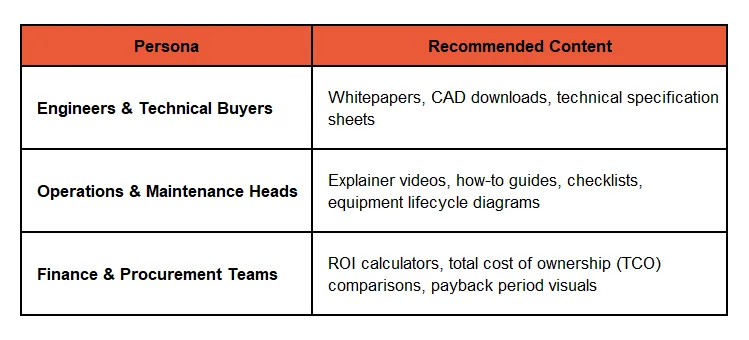
🧠 Tip: Use dynamic personalization to serve different content formats to different roles within the same account based on engagement signals.
📡 Channel Mix: Meet Buyers Where They Already Engage
Each industrial sector has its own preferred touchpoints, both online and offline. Matching your outreach strategy to these expectations ensures higher visibility and credibility.
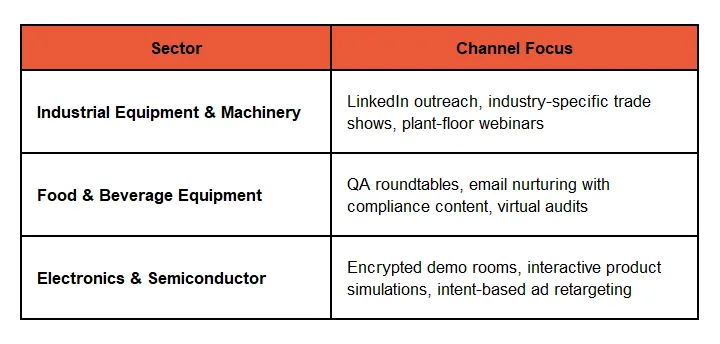
🧠 Tip: Invest in channel attribution to measure what’s actually influencing conversions, not just clicks.
📖 Sales Playbooks: Equip Teams with Sector-Specific Narratives
Generic sales scripts kill deals. Each vertical has unique objections, language, and priorities. Arm your sales team with modular playbooks that reflect those nuances.
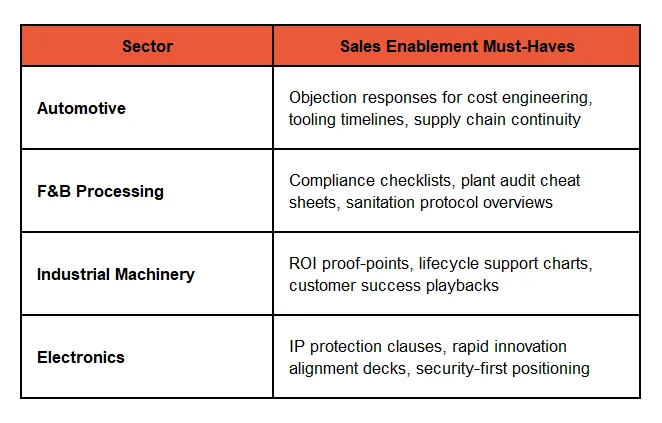
🧠 Tip: Involve actual account executives and engineers in developing these sector-specific playbooks for real-world relevance.
⏱️ Touchpoint Cadence: Calibrate to Sector-Specific Deal Speeds
Not every industry moves at the same pace. Your outreach cadence should reflect the buying velocity and decision-making structure of the sector you’re targeting.
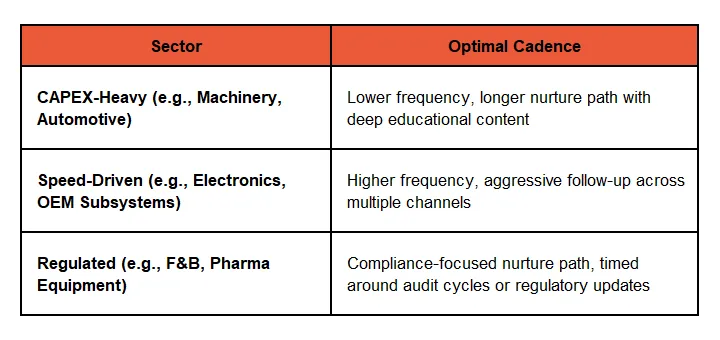
🧠 Tip: Use marketing automation tools to build sector-specific nurture tracks, adjusting touchpoint intervals and content depth accordingly.
✅ Bottom Line: Precision Wins
The more you tailor your ABM execution strategy to each sector’s quirks and culture, the more relevant your outreach becomes and relevance drives revenue.
Common ABM Pitfalls by Sector, and How to Avoid Them
Even the most sophisticated ABM programs can derail when execution doesn’t reflect sector-specific realities. What works in one manufacturing vertical might backfire in another, especially when messaging, timing, or stakeholder mapping is off.
Below, we break down the most common missteps seen in industrial ABM and how to course-correct before they cost you deals.
🚗 Automotive Components & Systems
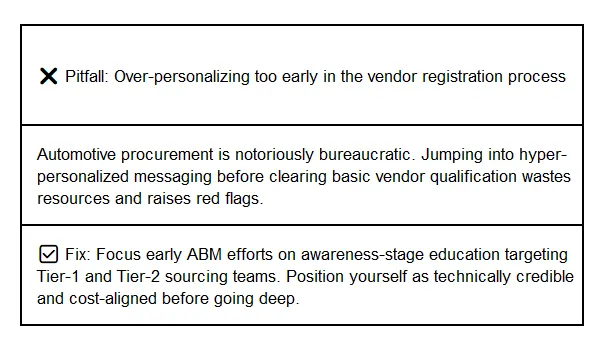
🧠 Pro Tip: Deploy high-level engineering use cases and compliance certifications as downloadable content behind minimal gate friction.
🏗️ Industrial Equipment & Machinery
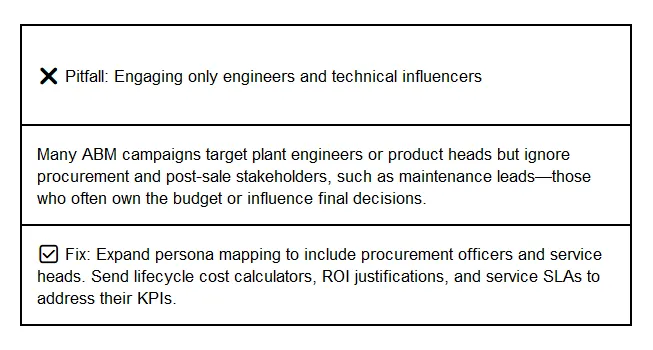
🧠 Pro Tip: Run persona-based nurture tracks simultaneously. What convinces an engineer won’t always move a procurement head.
🧃 Food & Beverage Processing Equipment
🧠 Pro Tip: Highlight third-party compliance audits and regulatory partnerships to build trust.
⚡ Electronics
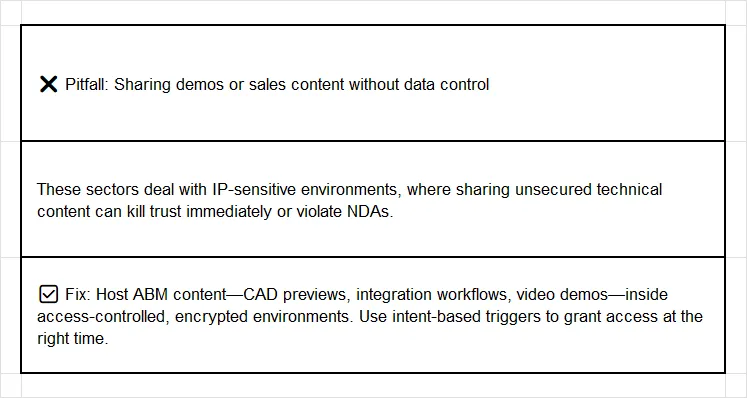
🧠 Pro Tip: Use one-time login portals with viewer tracking to ensure content isn’t forwarded or misused.
🧭 Bottom Line: Relevance Requires Restraint
Great ABM isn’t just about what you say, it’s about when, how, and to whom. Misjudging stakeholder priorities or sector-specific sensitivities leads to wasted effort at best… and lost deals at worst.
The best industrial ABM teams treat sector-specific context as sacrosanct. They customize not just content, but timing, gating, stakeholder inclusion, and data governance across every vertical they target.
Visual ABM Playbook by Sector
Designing an effective ABM campaign in industrial manufacturing is not about copying and pasting what worked for another vertical, it’s about sector-specific calibration.
Below is a visual ABM strategy matrix that distills the most critical strategic differences across four key manufacturing sectors. Use this as a quick-reference playbook when planning your next ABM campaign.
🧭 ABM Strategy Matrix: Industrial Manufacturing Sectors
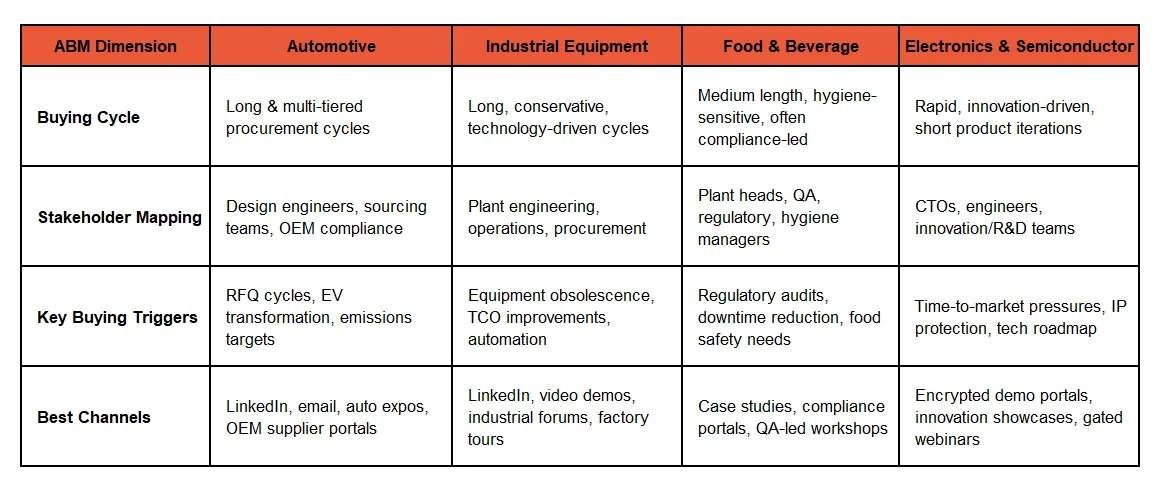
🧠 How to Use This Matrix
- Planning New ABM Campaigns? Start here. Calibrate messaging, timing, and channels based on the sector-specific norms.
- Launching Across Verticals? Use this to build playbooks per vertical, not just a single ABM track.
- Struggling with Engagement? Revisit this chart to check if you’ve missed key personas, misjudged trigger timing, or chosen the wrong channels.
📌 Insight: Just because you nailed ABM for industrial equipment doesn’t mean it’ll work for electronics. Sector-specific context isn’t a suggestion. It’s a strategy layer.
Why Sector-Specific ABM is the Future of Industrial Marketing
Let’s be brutally honest, generic ABM delivers generic results.
And in the industrial world, “generic” won’t win the deal.
Buyers in manufacturing aren’t just comparing vendors. They’re comparing:
- How deeply you understand their plant floor challenges
- Whether your content speaks to compliance, cost, and configurability, and
- How well your team supports them post-sale
That’s why sector-specific ABM isn’t a luxury, it’s a necessity.
✅ Automotive buyers expect sourcing documentation, not fluff.
✅ Food & Beverage leaders need proof of compliance/hygiene standards, not just savings.
✅ Electronics manufacturers care about speed and IP protection above all.
This isn’t about shrinking ABM down to fit your sector.
It’s about scaling it up intelligently, so that every touchpoint resonates, and every stakeholder feels understood.
-1.png)
-1.png)