
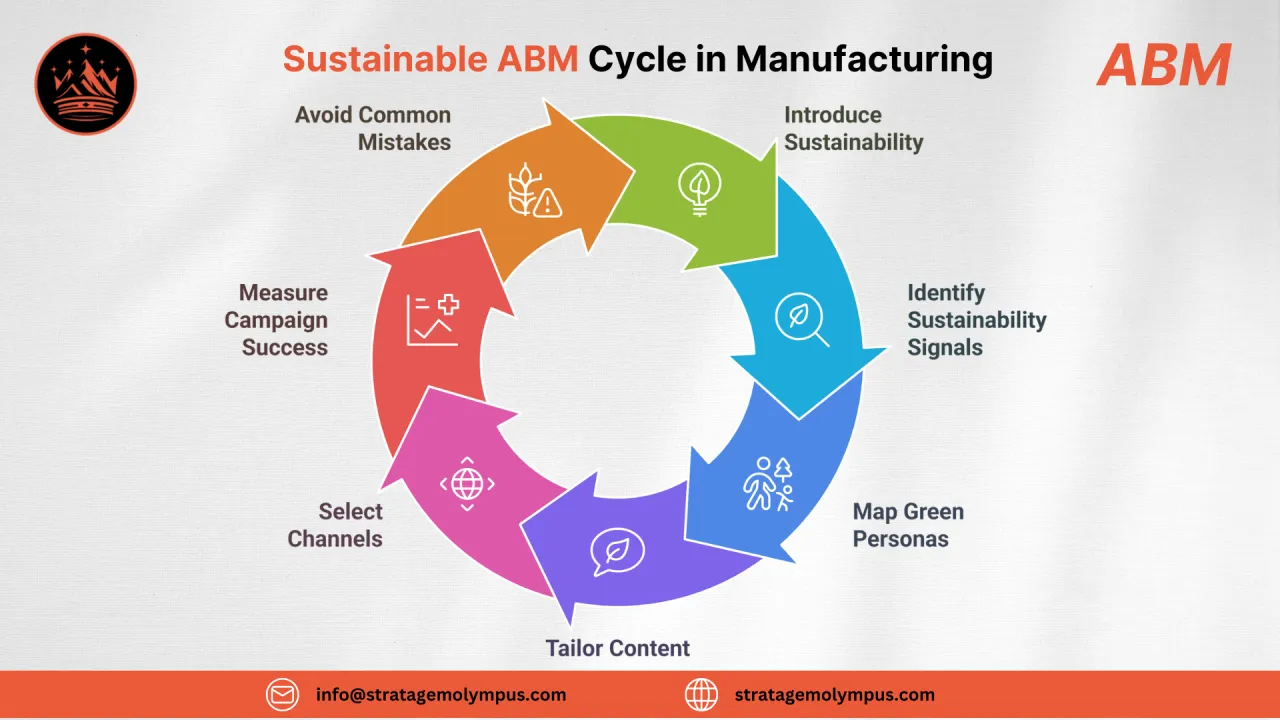
The New Imperative in Industrial ABM
In the high-stakes world of industrial engineering & manufacturing, a seismic shift is underway, not just in how products are built, but in how purchasing decisions are made. Procurement conversations are no longer just about performance and price; they now hinge on another key pillar → SUSTAINABILITY.
Across sectors like industrial machinery, food processing equipment, and electronics manufacturing, green compliance is rapidly becoming table stakes, not a ‘nice-to-have.’ Buyers, especially in mid to large-cap organizations, are under mounting pressure to meet internal ESG targets, comply with regulations like ISO 14001, REACH, or FSMA, and reduce their environmental impact across the supply chain.
This is where Account-Based Marketing (ABM) becomes not just relevant, but essential.
ABM has always been about relevance and precision. In an era where sustainability is a serious business prerogative, ABM offers the only realistic pathway to convey a manufacturer’s environmental commitment at a personalized, account-specific level.
- 🌍 An RFQ for a food packaging machine might now include sections on material recyclability and energy efficiency.
- ⚙️ A plant head considering a retrofit for hydraulic systems will be swayed not just by lifecycle cost, but by emissions metrics.
- 📊 A sourcing manager may shortlist vendors only after assessing ISO and GHG reporting disclosures.
Sustainability is no longer a vertical, it’s a lens through which every buying committee evaluates risk and reward.
🔎 In fact, 66% of global B2B buyers say they “prefer to buy from suppliers with sustainability policies”, and nearly half say they’ll drop vendors who don’t meet ESG benchmarks.
So, what does that mean for your ABM strategy?
It means your marketing narrative must evolve. From sharing just tech-specs (like most companies) to showcasing sustainability differentiators. From pushing product features to proving environmental impact.
In this blog, we’ll unpack exactly how industrial engineering manufacturers can:
- Detect sustainability buying signals
- Engage ESG-driven stakeholders
- Align ABM content and channels to reflect green priorities
- And most importantly, earn preference from sustainability-focused accounts.
Let’s dive in and explore how sustainability is redefining precision marketing in industrial manufacturing, and why green ABM isn’t a marketing trend, it’s a strategic advantage.
Sustainability Signals in Industrial Accounts
Most traditional ABM strategies are trained to detect buying signals like new funding rounds, leadership hires, or expansion announcements. But in today’s sustainability-first manufacturing climate, those signals only tell half the story.
The new-age buying intent includes signals like:
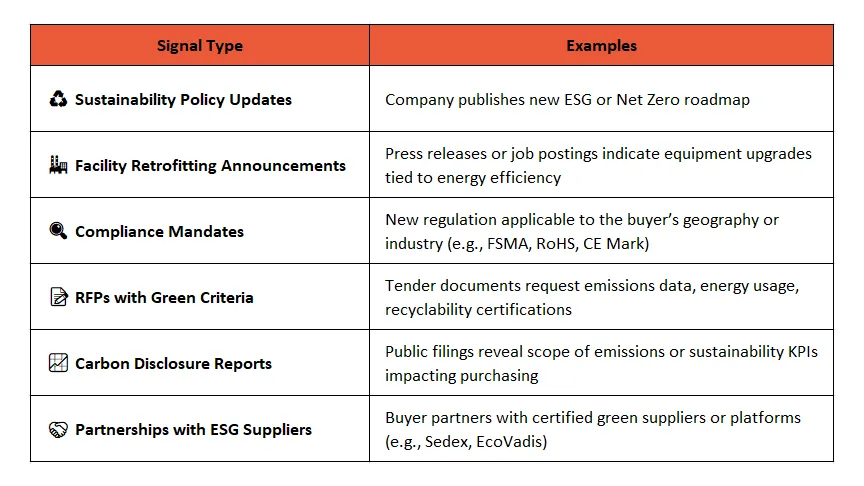
These are micro-events that signal an account’s shift toward sustainability, and they should be treated as Tier-1 ABM triggers.
🔍 Real-World Insight: In a 2023 Deloitte survey, 54% of industrial manufacturers said they had already embedded sustainability metrics into their supplier selection process.
How to Detect These Sustainability Signals?
To make these insights actionable, ABM teams need to upgrade their research and monitoring stack. Here’s how:
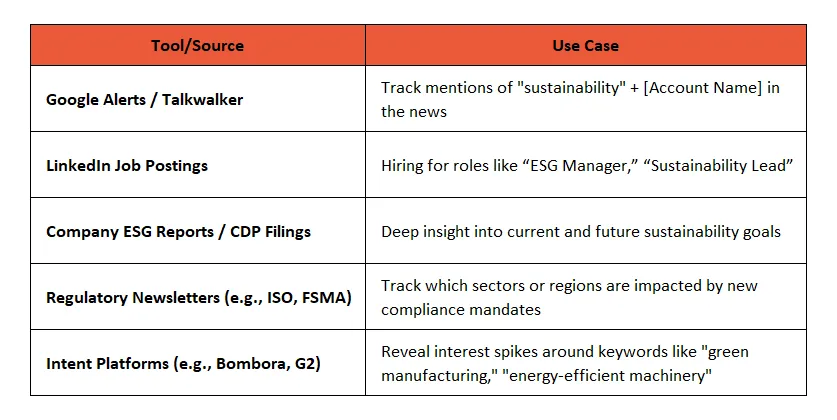
By aligning ABM activation with these sustainability buying signals, your outreach becomes both timely and contextually relevant. That’s the difference between being part of a shortlist, or being part of the ignored noise.
🚨 Pro Tip: Set up custom intent tracking for sustainability-aligned signals across top target accounts, just like you would for funding or M&A events.
Mapping Green Personas in the Buying Committee
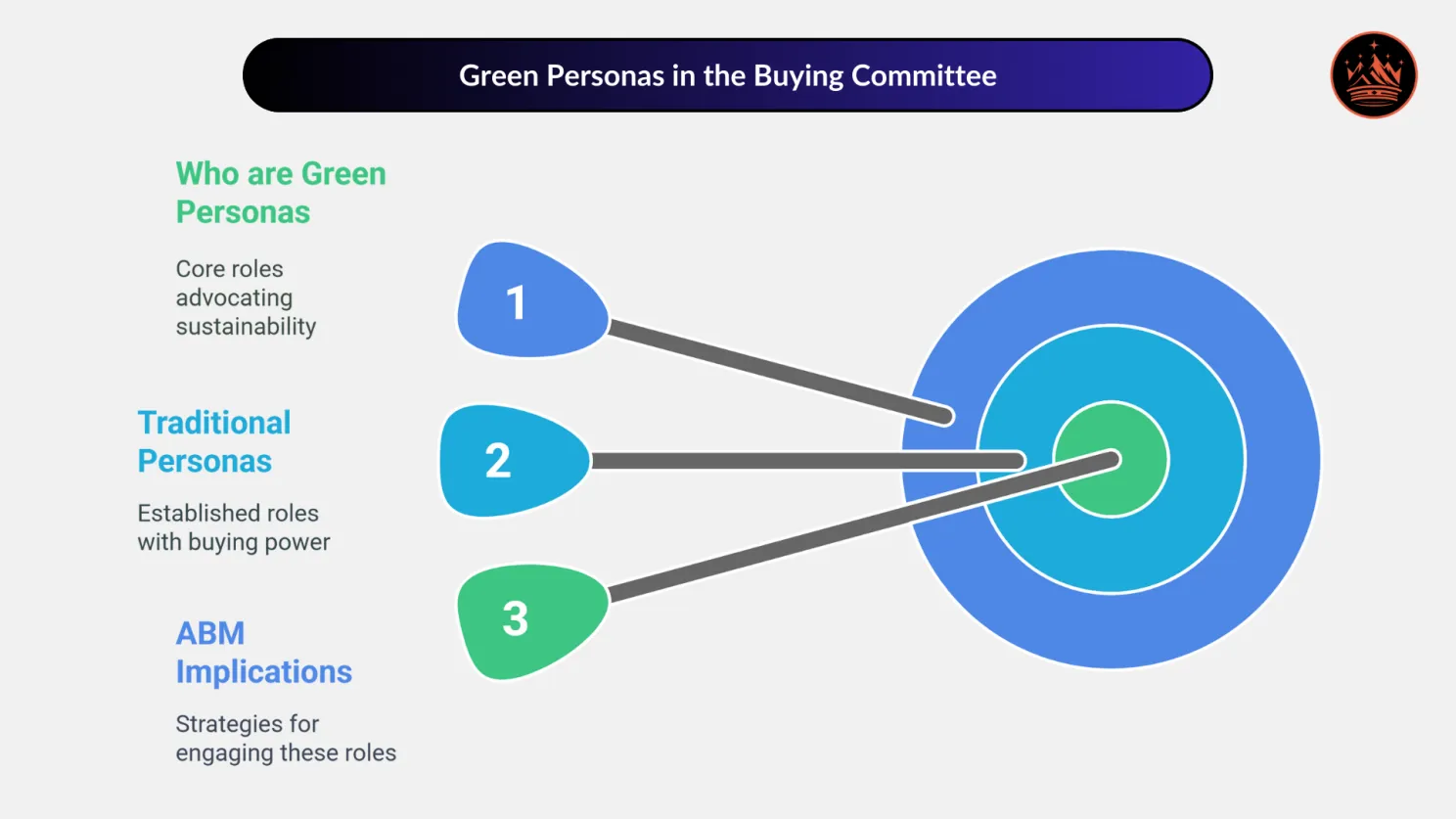
In traditional industrial ABM, you’re familiar with key personas: Engineering Heads, Plant Managers, Procurement Officers, and so on. But in sustainability-conscious accounts, a new layer of stakeholders emerges, Green Personas. These roles may not control the budget directly, but they increasingly influence vendor selection and compliance alignment.
👥 Who are the Green Personas?
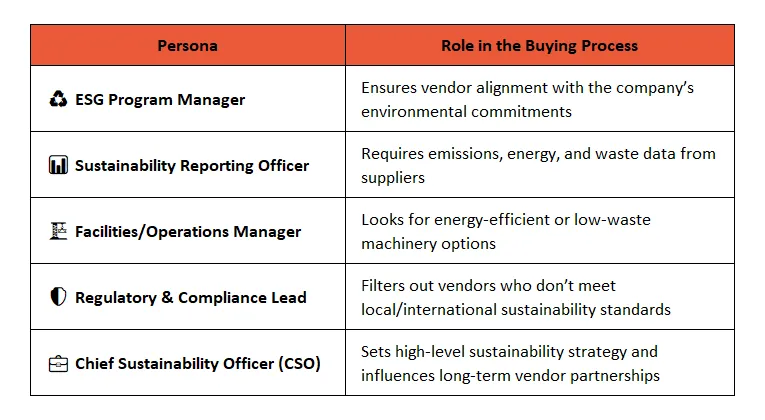
💡 Important Distinction: These personas often sit outside the traditional procurement loop, but their input can veto a deal or push an alternative vendor that’s more sustainability-aligned.
🎯 ABM Implications for Targeting These Roles
To run effective ABM campaigns in sustainability-driven accounts, your messaging and engagement tactics must be tailored to these sustainability (green) personas.
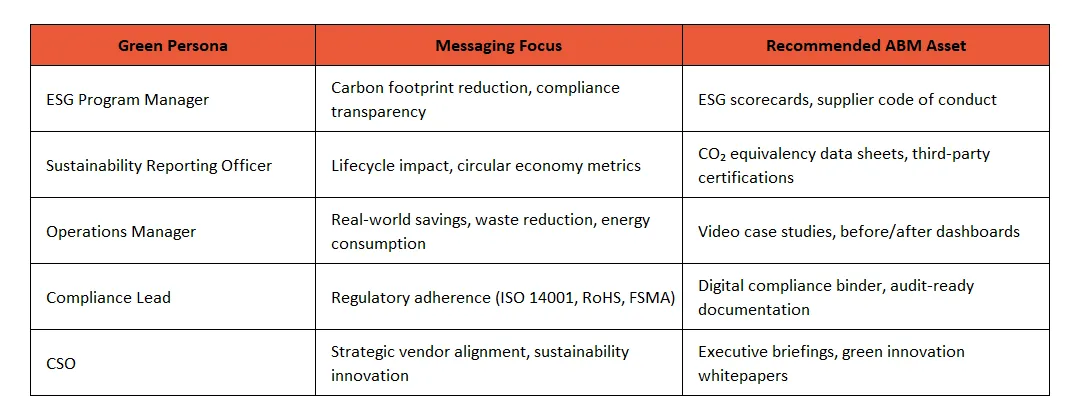
🧩 Cross-Mapping Traditional & Sustainability Personas
Here’s how traditional roles and sustainability roles intersect within the buying committee:
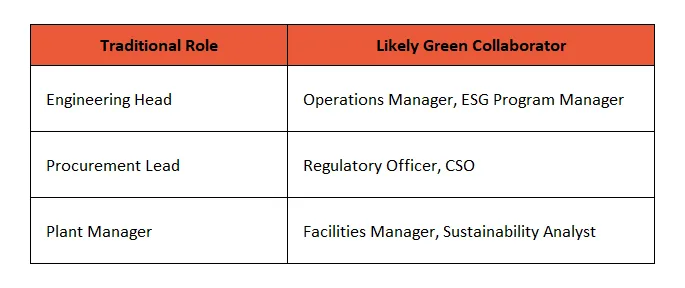
🧠 Strategy Tip: For accounts with no publicly listed CSO, map proxies, such as ESG reporting managers or members of a sustainability council, and tailor your outreach.
ABM that fails to engage these sustainability personas is flying blind in today’s industrial buying landscape. Whether your solution is eco-efficient machinery or compliance-ready components, your ABM program must now account for the sustainability (green) voices shaping the deal.
Content that Speaks Sustainability – Tailoring Messaging for Eco-Conscious Accounts
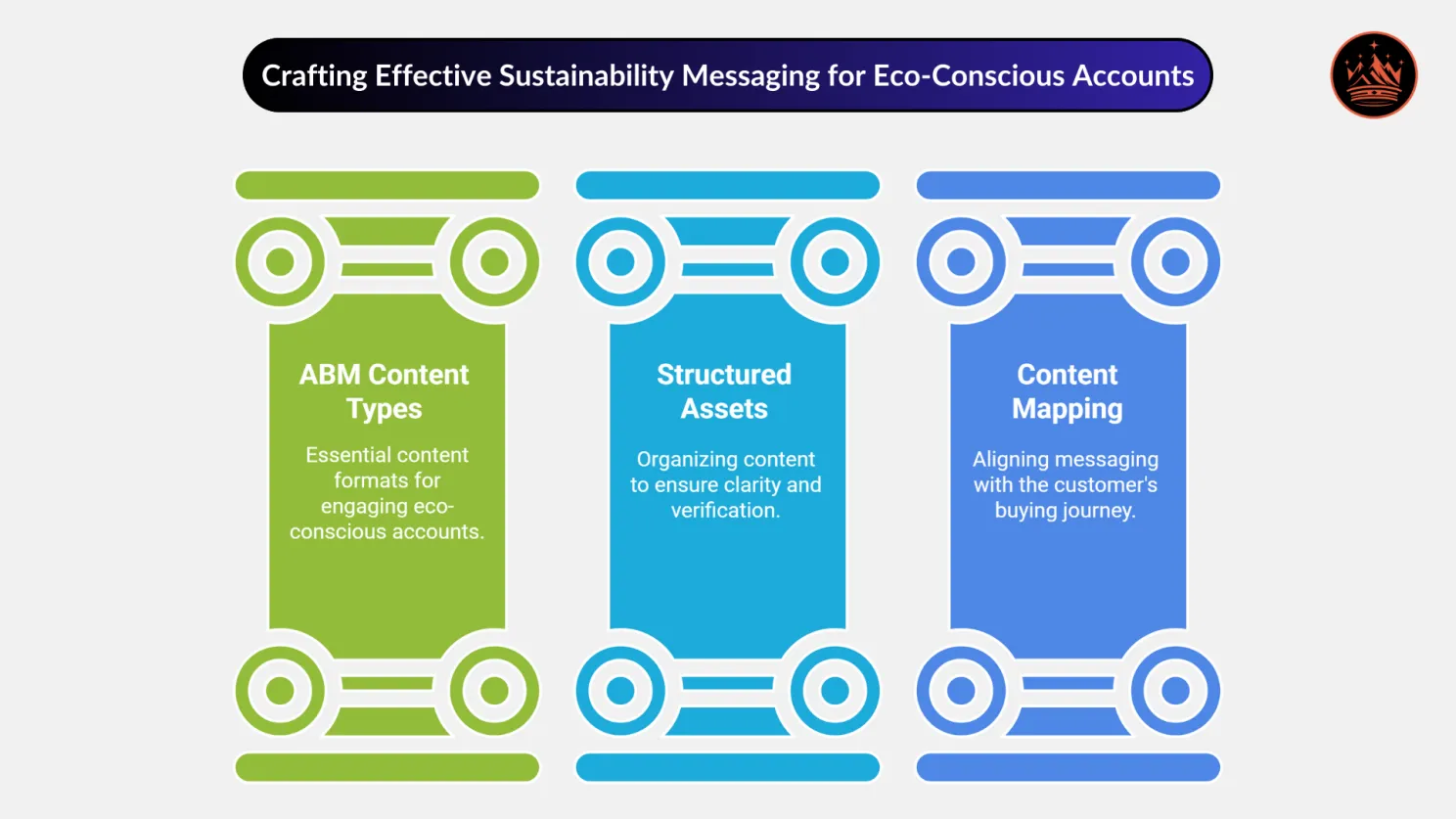
Industrial ABM has always demanded tailored content, but when targeting eco-conscious accounts, the rules change. You’re not just demonstrating technical performance; you’re proving your climate credibility, compliance alignment, and long-term environmental value.
Sustainability-driven buyers want more than buzzwords. They want specifics, proof, and relevance.
🧠 What Sustainability (Green) Personas look for in Content?
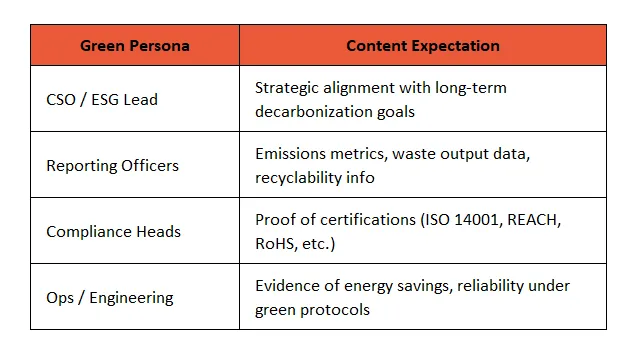
🧾 Must-Have ABM Content Types for Sustainability (Green) Accounts
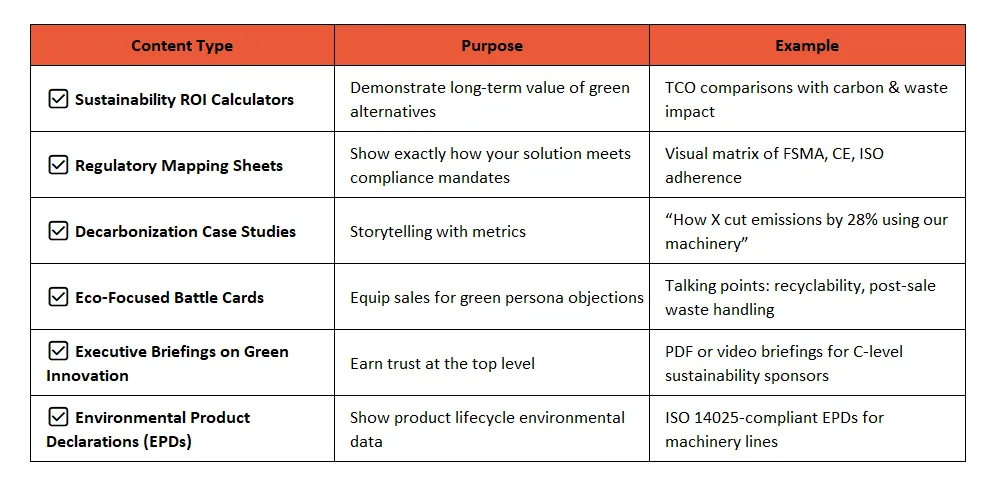
📌 Insight: According to a 2023 McKinsey report, nearly 70% of industrial B2B buyers said that a vendor’s sustainability messaging influenced final selection, even when pricing was comparable.
📦 Don’t Just Say It, Structure Your Assets for Verification
Eco-conscious stakeholders are trained to spot greenwashing. To earn credibility, your content must be:
- Cited & Certified: Use third-party certification bodies and lifecycle assessment tools (e.g., TÜV, SGS, ISO LCA).
- Visualized Clearly: Present CO₂ reduction or energy savings in charts, not walls of text.
- Segment-Specific: Speak differently to a food processing QA head than to a heavy equipment plant engineer.
🧩 Content Mapping Matrix: Aligning Messaging to Buying Journey
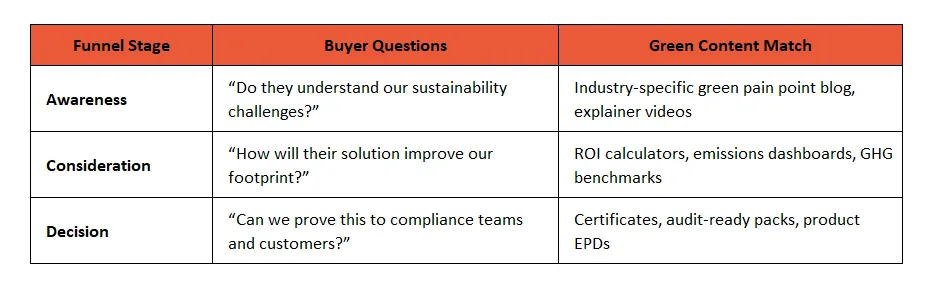
✅ ABM Success Tip: Personalize not just what you send, but when you send it, serve your greenest content post-demo, when the buying committee needs to justify the deal internally.
Choosing the Right ABM Channels for Sustainability Messaging
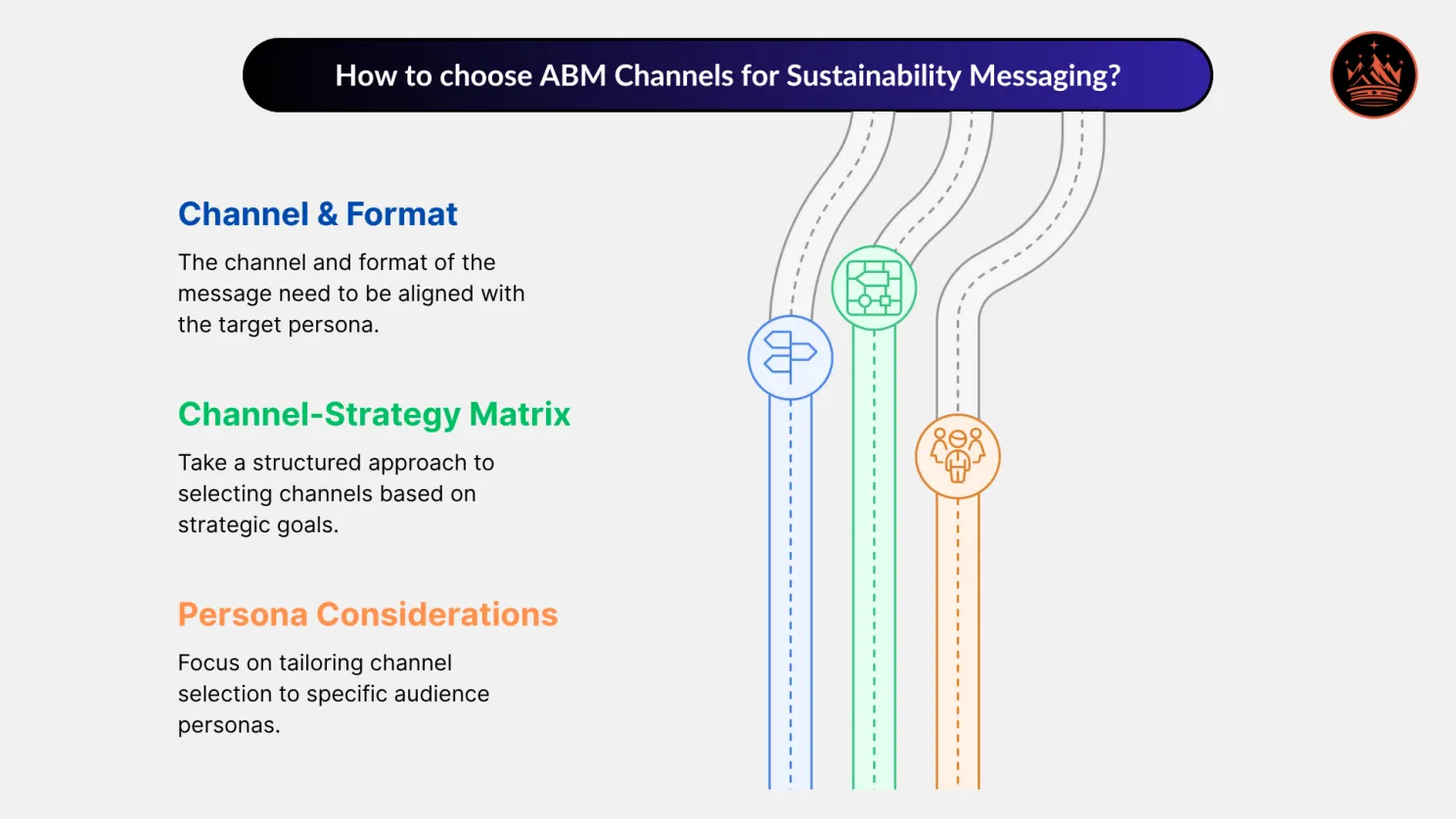
Sustainability messages don’t just need to be compelling, they need to show up in the right place, at the right time, for the right stakeholder. In industrial ABM, every channel must carry the weight of proof, trust, and precision.
🎯 Key Consideration: Channel ≠ Format
You don’t just “use LinkedIn.” You deploy sustainability messaging to specific roles, in specific formats, at strategic moments.
Let’s unpack how.
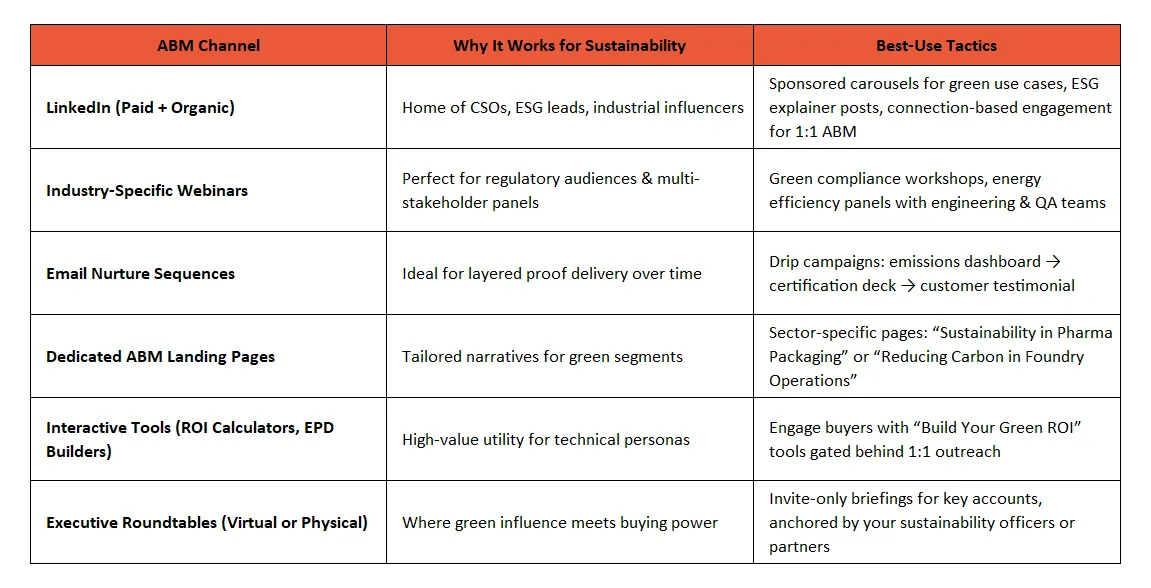
📡 Channel-Strategy Matrix for Sustainability-focused ABM
📍 Pro Tip: Sequencing > Spamming
The success of your Sustainability-focused ABM campaign isn’t how many channels you use, but how intelligently you sequence them:
- Start with educational awareness on LinkedIn or webinars
- Nurture curiosity via email or paid content (Ads)
- Deliver proof & performance through gated ROI tools or microsites
- Invite decision-makers to private events or demo experiences
Measurement Metrics for Sustainability-led ABM Campaigns
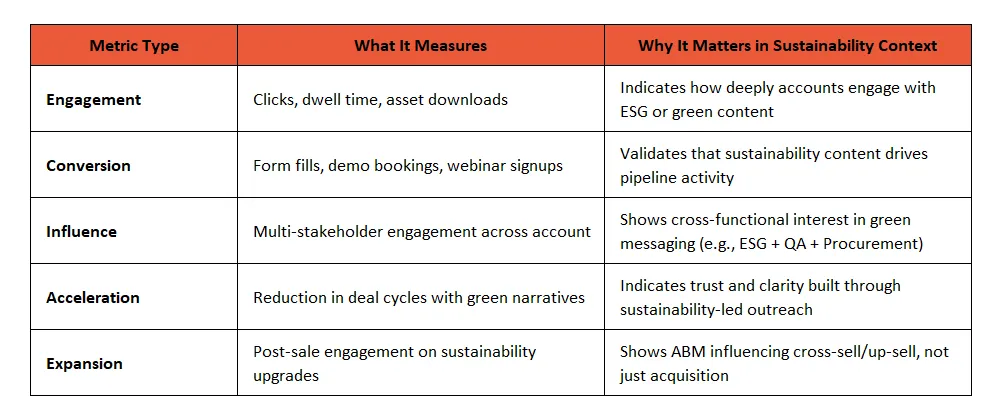
In sustainability-led ABM, it’s not just about tracking clicks or open rates. It’s about proving resonance with ESG priorities, validating your green value proposition, and surfacing high-intent buying signals from accounts that care about the planet and their profit margins.
Let’s break down what matters.
📊 Core Metric Categories
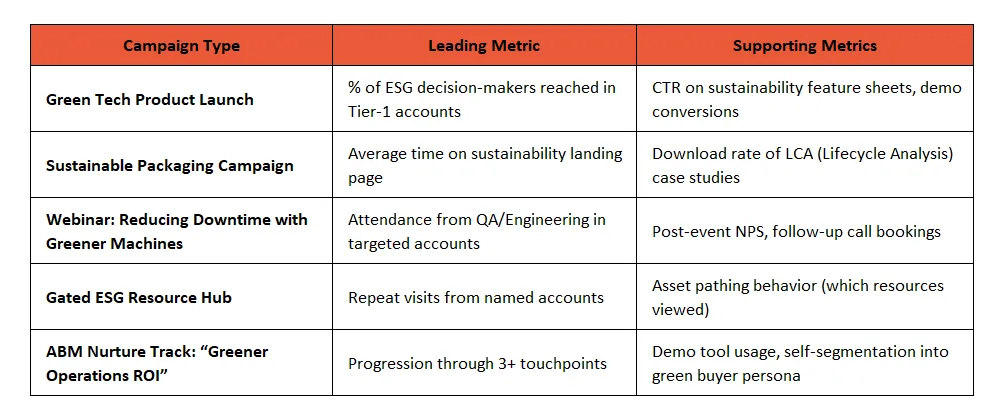
📈 Sample Metrics by Campaign Type
📍 Remember: ESG ≠ Vanity Metrics
While vanity stats (likes, shares) feel good, they rarely drive revenue. Instead, optimize for:
- Behavioral intent (demo requests, repeat content engagement)
- Multi-persona touches (procurement + compliance + ESG)
- Content-influenced pipeline velocity (faster movement across pipeline stages)
Measuring sustainability-led content’s impact on pipeline isn’t a box-ticking exercise. It’s your signal that buyers trust you to align with their values, not just sell them a product.
Common mistakes in Sustainability Messaging, and how to avoid them
Sustainability-led messaging is a strategic ABM differentiator, but only when executed with precision, clarity, and credibility. Many industrial manufacturers stumble here by either oversimplifying or overhyping their sustainability positioning.
Let’s decode the most frequent pitfalls and how to fix them:
❌ Mistake 1: Greenwashing with Vague Language
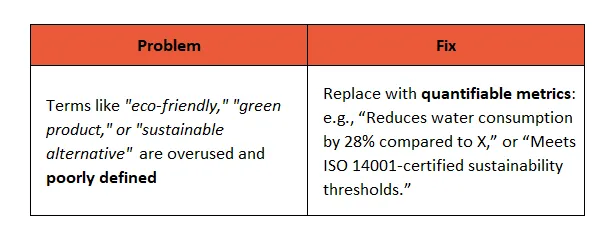
✅ Credibility is earned with precision-backed proof, not feel-good fluff.
❌ Mistake 2: Ignoring Technical Buyers in ESG Messaging
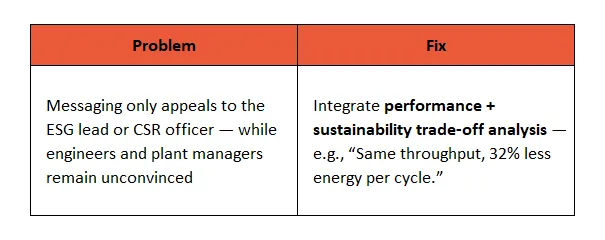
🎯 Your ABM content should prove sustainability doesn’t come at the cost of performance.
❌ Mistake 3: One-Size-Fits-All Sustainability Content
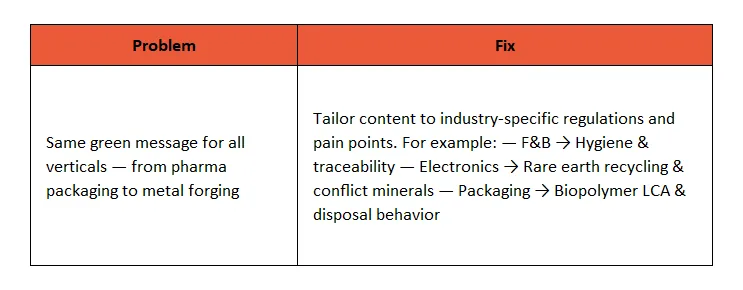
🧩 ESG relevance is sector-specific. Bake it into your ABM persona mapping.
❌ Mistake 4: No Proof of Post-Sale Sustainability Impact
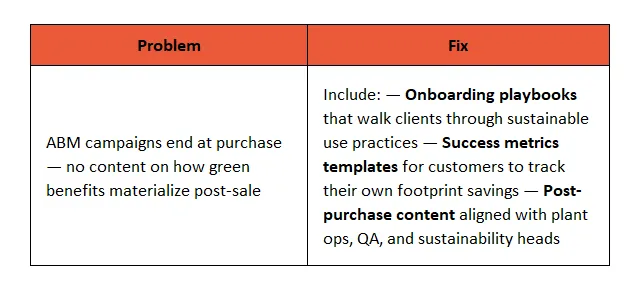
🔁 Remember, ABX = Post-Sale Trust + Long-Term Value
❌ Mistake 5: Over-reliance on Webinars & Whitepapers
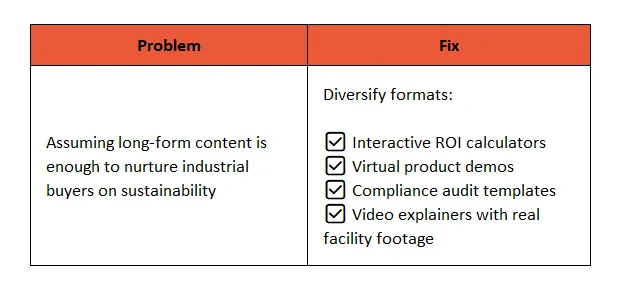
🎥 Visual, utility-driven content earns more trust than long blocks of ESG jargon.
📌 Bottom Line:
In industrial ABM, your sustainability-led (green) message must be engineered with the same rigor as your product. It should:
- Educate without overwhelming
- Prove without preaching
- Drive revenue while aligning with ESG values
Only then will sustainability become a real differentiator, not just a line in your brochure.
Sustainability as an Industrial ABM Differentiator
In today’s industrial landscape, sustainability is no longer a side note. It’s a strategic buying criterion. From procurement heads in global conglomerates to QA officers in regulatory-heavy sectors, every touchpoint in the industrial buying committee now expects environmental responsibility to be proven, not pitched.
Industrial ABM - Account-Based Marketing is your vehicle to do just that, with:
- Tailored ESG messaging aligned to sector and persona,
- Credible proof points instead of vague sustainability claims,
- And a post-sale journey that turns sustainable value into measurable business outcomes.
💡 The Takeaway?
The future of ABM in industrial manufacturing will be won by companies that not only deliver product value, but do so responsibly, transparently, and intentionally.
If your ABM content still says “eco-friendly” without showing the math, your competitors will win the sustainability conversation.
-1.png)
-1.png)